Learning in the Open: Networked Student Identities

This weekend, I gave a short presentation at a great little student conference hosted here at UPEI: Difficult Dialogues: Exploring Relationships Between Identities and Power.

(When I say “short” I mean I was still talking when the poor timekeeper started waving the STOP sign in front of my face: it’s been awhile since I tried to encapsulate ideas into fifteen minutes.)

I made a few quick alterations to the slides after the presentation thanks to the really good questions and conversation that emerged, and in hopes of making the ideas reasonably clear on Slideshare even without an audio track. This is the first time I’ve really taken up this particular thread on the intersections between “student” and “networked learner”, so thanks to everyone at Difficult Dialogues for engaging with and supporting these ideas as I begin to work them through.

Learning in the Open:

It’s what I didn’t say that’s more interesting, though
The fact that I ran over time is apt, given how it mirrors my own current overwhelm as a learner.

The presentation troubles some of the categories of student that academia comes with, and how differing forces and logics govern the two spheres and the way learning is practiced within them. But I didn’t go far enough. While I’m a living, breathing advocate for the benefits of networked learning, it may be the problems with it that are the most instructional.

The keynote for the conference this weekend was S Bear Bergman, who gives one hell of a talk on sex, gender and trans identities.  And while what I do may not intersect on the surface with Bear’s work as a thinker or a presenter, ze reminded me of something I know but have failed to transfer over to my analysis of learning and learners.

We are always signalling and reading 
Engaging with each other as humans is a process of reading codes and signals.

(Okay, not entirely perhaps: I won’t wade into the “we are all texts” ontological discussion here.) But if our material and discursive signals  to others aren’t readable or legible within the frameworks by which they comprehend the world, we tend to be rendered Other: either seen as transgressive or simply not seen at all.

In identity terms, visibility and speakability are necessary for legitimacy, for non-erasure. Only in the past few years have the identity signals and codes performed by queer and trans people begun to become readable and speakable on a scale that extends beyond those communities and makes those identities visible within the broader society. And slowly, slowly, mutually constituted with the very possibility of this legibility of trans people, society’s concepts of sex and gender are shifting.

Signalling networked learning
So perhaps it is with networks, though with far less advocacy, pain, marginalization and struggle, let me be very precise. But I believe learning – whether in online social networks or straight from the canon, bound in leather – involves being able to read and make sense of the codes and signals being given off by those you interact with, particularly those you expect to learn from. These are what I refer to when I talk about “legitimacy structures” within academia and networks in the final slide of the presentation above.

Screen shot 2013-02-10 at 4.15.47 PM
They are, in a sense, literacies. They’re what I’m stumbling towards when I talk about the networked or digital literacies that MOOCs – if they connect people – help develop.

I’ve been struggling to say what I research lately. Is it social media? Identities? MOOCs? Networks? My research is a process of trying to grasp and make visible a few ideas and realities from the midst of a flood. It’s about filtering and reflection and constant observation of moving targets. My sense of focus doesn’t shift so much as the ways in which it’s likely to be understood change all the time.

Part of the problem is filtering: I’ve realized recently that in my dissertation work I’ve failed, so far, to build a robust framework through which I can filter the seven hundred vaguely-related-to-the-Internet-and-learning-and-identities ideas that I encounter out here every day in my brilliant network. I meander in circles, fumbling to re-word and re-work things, trying to translate or adapt concepts I encounter and figure out whether they fit into the big picture of what we’re doing out here in this world of networked practice. Sometimes they do. Often they are rabbit holes. Seldom can I tell the difference in advance.

But what I learned at the conference on the weekend is that the filters and structure aren’t the whole challenge: how to translate and signal what I’m learning to two different audiences is also a process I’m going to have to address overtly. Because there are power structures that support and prop up societal views of knowledge that make networked knowledge and practices appear invisible or illegitimate.

For the many networked learners who are also formal students, this can be a very real problem: it can negate or frame as transgressive what is simply different. And within fields of knowledge and the academy in particular, it makes pressing contemporary conversations about online learning into polarizing and misleading soapboxes about what counts as real.

The fact that networked learners DO have signals and codes by which we connect and speak, though? Is a very important – and useful – fact. Because signals and codes – like all things that are read – can be learned.

The lack of face-to-face is not a void, only a lack of literacy
Whether networked learners are formal students within the academy as well, or no, many of us regularly come across sincere – and often deeply-thought-out objections – to the idea of online learning in general, and to its lack of the ineffable quality of authenticity in particular.

I think there are multiple axes of thought behind these objections, some of which lie in determinism or digital dualism or nostalgia or overt privileging of the physical over the virtual. But even among many participants of the MOOCs I’ve engaged in so far this winter – #MOOCMOOC, #etmooc,and #edcmooc – I see a strain of genuine hesitation to fully embrace networked learning as legitimate, or at least as AS legitimate as face-to-face learning.

And I think it’s a literacy issue. These people are, for the most part, highly traditionally literate – many are teachers and academics – and they are, to their great credit, game to give networked learning a try even if they’re not entirely sure it’s valid. But they are new to the game, and they haven’t yet put in the longterm immersion and reflection usually required to build literacies in a new environment: they can’t yet read the signals and codes by which we interact.

Because networked learning is not about technologies, or a lack of the human touch: these are simply common and understandable misconceptions given the narratives that circulate in our culture on the subject. Rather, if it’s truly about networks and not just mass broadcast, it’s about engaging with humans; about performing networked identity via the codes and signals that we digital selves share openly.

Just because that may not be visible doesn’t mean it doesn’t exist. But those of us to whom it is visible…we have a job ahead to continue to assert and translate and help make our identities readable and legitimate in the field of knowledge.
Connected Learning: Getting Beyond Technological Determinism

Life lately has felt like one of those dreams where you’re in a cab with your third-grade teacher on the way to a conference presentation you forgot to prepare for and then suddenly the cab morphs into a giant recycling plant and everything is spinning and…

What? You don’t have those dreams?

I have them when things get busy. It’s like a grand exercise in convergence: everything blurs together.

From the midst of the blur, though, there’s a thread I want to try to untangle from the early weeks of #etmooc (Educational Technology and Media, a collaboratively-hosted connectivist MOOC) and #edcmooc (E-learning and Digital Cultures, my first Coursera effort, offered through the University of Edinburgh). I’m taking both at once, in admittedly a bit of a peripheral way.

But the ideas are starting to bounce off each other and amplify…and then weave back together around this thread of technological determinism. Or, as I like to call it, the spectre haunting networked culture.
***

Technological Determinism 101
We live in a culture saturated with the idea that technologies are, effectively, things in themselves, in spite of the fact that they arise from and are utilized and therefore given meaning within particular social and cultural contexts. We tend to see technologies in terms of their “thingness” – their shiny gadget glory – rather than in terms of the affordances or action possibilities they enable in different societal situations. This separation of thing from context and possibility leads  to determinism, or the belief that machines have the capacity to act on us and do things to us in and of themselves.

Determinism has a long and fairly star-studded history: from Socrates’ laments about what writing would do to memory through Marshall McLuhan and down to Nicholas Carr’s present-day ideas about Google making us stupid, lots of smart and famous people have forwarded rather deterministic views of the technologies of their times, during those times. Determinism tends towards answers in times of change. Could be why it’s popular?

Now, I’m not saying all determinist conclusions about technologies are wrong. What I am saying is that the way determinism gets to them creates problems. Determinism tends towards a reductionist view of what technologies are and do, assuming direct cause-effect relationships between technologies and what they make possible. Determinism also tends to attribute social phenomena that occur around given technologies to the technologies themselves, rather than what they stand for or enable or afford. Therefore, it renders the perspective on those phenomena forever skewed and tech-focused, so long as the determinist lens is still in place.

What’s wrong with that? Lots.

Technologies Don’t Connect People: Networked Relationships Connect People
The current American gun control debate is perhaps the most dramatic lens through which to illustrate the ways in which technological determinism makes for stupid arguments. On both sides of the fence.

Determinism is, in effect, a world view; one that reduces societal phenomena to “technology x did thing y.” The rest of the factors involved in the conversation get obscured or intentionally dismissed: the power of the technology to act is assumed, even when the determinist is arguing against the statement being put forward. Thus the anti-gun-control maxim “guns don’t kill people; people kill people” isn’t knee-jerk anti-determinism but actually determinism at work. It effectively controls and reduces the conversation to an assertion that guns get up by themselves and commit murder, and then smacks that down.

Now, maybe some people actually believe guns act like the brooms in Fantasia, multiplying and sweeping all by themselves. Most arguments for gun control and gun bans don’t actually operate that way, though. Those that do are determinist, and not very convincing, IMO. Guns and their availability absolutely DO lead to increased numbers of deaths, but no, generally not without people to pull the triggers.

What determinism does, though, is keep the conversation focused around a simple if specious cause-effect assertion and away from the whole host of demographic factors and identity factors and cultural factors that put people at risk from guns and support the arguments for restricted access. Determinism dismisses complexity and reinforces the idea that societal equations are simple, even when it’s pressed into service against simple equations few people are actually making. Culturally, we are trained and conditioned to accept technological determinism as common sense. So the very presence of determinism makes an important conversation hard to have, because effectively…the parties aren’t IN the same conversation, much of the time.

What does this have to do with networks and the admittedly less urgent issues around connected learning and the MOOCs I’m hanging out in? I think determinism and its prevalence as a cultural worldview are a very big part of what make the whole purpose and point of networking essentially invisible to those who aren’t immersed in it.

And I have #edcmooc and #etmooc to thank for converging to point that out to me.

Tech Utopias and Tech Dystopias are All Determinism
The very first week of #etcmooc boldly opened the conversation about digital cultures from an exploration of both Utopian and Dystopian perspectives on digital technologies within cultures, as well as a great foundational reading arguing against determinism. Part of me is tickled by this, because it’s making for great imagination fodder in the tweets and discussion, but I also note that the flights of (really artistically compelling) determinism represented by the best Dystopias and Utopias tend to reinforce the same worldview . Like the “guns don’t kill people” mantra, Dystopian and Utopian narratives frame thinking about technologies in their own binary good/bad terms. So it’ll be interesting to see if and how the class actually breaks down those binaries as we carry on, or if we get stuck there, endlessly debating whether digital culture is Utopic or Dystopic.

For my part, I think digital culture – and particularly networked culture – is neither. It has elements of good and bad, but good or bad is, from my non-determinist’s lens, the wrong question to even be asking.

But I do think determinism gets in the way of many of the conversations I try to have about networked culture, as a teacher and a scholar and a blogger whose work is largely about framing this complex set of practices within various non-networked contexts.

How the Add-On Perspective Misses the Point
I saw this again last night, when I tuned into George Couros‘ #etmooc discussion of connected leadership. George is an actively networked Division Principal who shares his learning and his educational practice, and who advocates for encouraging this type of connection across educational communities and between stakeholders.

In the backchannel chat on Collaborate, there was a lot of anecdotal discussion of the differences connection – ie building networked professional profiles via social media – has made for many of us, as well as a particularly skeptical response from one participant who kept saying things along the lines of, “but we didn’t have social networking sites when I was a kid, and I turned out fine.”

In my life outside of MOOCs, I meet a lot of people with these kinds of positions on social media. Many of them are my loved ones, my good friends, my colleagues and teachers. Many of them have also never really tried the things they dismiss so easily, so kudos to the dude in the #etmooc chat for being willing to engage in the networked environment of the MOOC long enough to make the point, at least.

But it is a point that tends to miss the point. It’s a point that assumes social networks are an add-on, an extra…essentially a tech toy or a diversion from the “real” work or “real” sociality that makes the world go round. This is digital dualism, but it’s also determinism at work. It hears all this enthusiasm about connection as about the social networking platforms themselves – “yay blog!’ or “yay Twitter!” – and not about the connections and actions and forms of identity that those networked environments make possible.

Determinism reduces conversation about social networks to a conversation about platforms and tech, not about people and the ways in which they intersect with those platforms and tech to create new possibilities. It effectively mutes those latter parts of the conversation; refuses them admittance. It insists that a conversation about technologies’ effects is a conversation about the technologies themselves.

Twitter is not a Ferrari
Subtle distinction, maybe. And one that we’ve been acculturated to miss: enthusiasm related to technologies WAS mostly about the tech platform itself, back in the mechanical and even early digital ages. If I’m excited about driving a Ferrari, for instance, it’s likely not the fact that I’m off to see Grandma or wide open spaces that is actually the focus of my excitement, but rather the Ferrari itself.

Now, Twitter is no Ferrari, but early – and pervasive – geek culture stereotypes tend to perpetuate this narrative of the hard-on for the thing in itself rather than what it affords. And those of us who don’t self-identify as geeks – I’m one, for all my immersion in the digitally networked sphere – are trained to recognize this narrative as Other and thus reject it.

Thus to those who’ve never really used a social network other than FB, where you’re pretty much talking to people you know, the chatter about how marvellous being a connected educator or scholar or simply human can be probably sounds a lot like “yay Twitter!” They look at us, and think, “man, those people get TOO excited about 140-character-limits on expression” and we all go about our merry business still completely misunderstanding each other.

Does Connection Minimize Technological Determinism?
The narratives we have around technologies and society and their intersections aren’t hugely visible to most of us. And they tend to shift with use: I have yet to see anyone deeply embedded within networked culture – whether as an educator or a momblogger or a poet – who has a determinist view of technologies. This isn’t a matter of chicken-egg…over nearly seven years, I’ve watched even people who started out quite convinced that their online lives were an add-on utterly separate from their real lives and that blog platforms were fun in and of themselves move to deeply embedded networked identities.

But many don’t start. And I’m thinking maybe being able to recognize technological determinism and address it directly might give those of us who find value in networked connections and connected learning an important tool for building better conversations about this, and therefore better connections.

A Bill of Rights and Principles for Learning in the Digital Age

I’m one of the people who collaborated on and signed the document below.

It grew out of a small gathering in California last month, where there was much raucous debate about online learning and the future of higher ed. Our conversation initially centered around MOOCs, but shifted, as MOOC conversations tend to. See the story in The Chronicle. 

One of the ideas it shifted to was that of a Bill of Rights for Learners in the myriad online/hybrid courses and enterprises that MOOCs seem to be spawning. Not every institution of higher ed will be jumping into partnership with Coursera or Udacity, but many are having to rethink online learning-  the IHE today says 47% of provosts think MOOCs threaten the business model of their institutions – and in this flurry to get in the game, the pedagogy/peeragogy aspects of online learning aren’t always front and centre. Nor is the nearly two decades of solid educational research in this area (I’m waving at you, Open University!) always well-known.

The key point of the Bill is that as online learning suddenly seems to be hitting the mainstream of administrative and faculty conversations, against the backdrop of MOOCs and fiscal pressures, it’s important that changes be made with learners at their centre.

I was – and still am, to be honest – a bit uncomfortable with the Bill of Rights language, and haven’t fully unpacked that. It may just be my Canadian ears. It may be that I’d rather stay away from Enlightenment language like “rights” for other people, even if I *am* a student and a learner both. Matters not, now: it’s named…at least for the moment. And open for edits and input and hacks, in hopes that it becomes something more than it is.

In the next year, many of us in higher ed will find ourselves designing some form of MOOC or hybrid or online course. For me, that’s exciting. I’ve taught online since 1998. MOOCs are an opportunity for me to actually focus my teaching and research expertise into the same piece of course design. But for most in higher ed that’s not the case. So perhaps this Bill will start some conversations and provide/provoke some ideas for those pressed into service on this “new” frontier. It will not solve the majority of the issues MOOCs raise. But it may help re-focus the conversation on learners and learning, which matters.

And it may – I hope – foreground the importance of learners as teachers and peer teachers, beginning to shift the power relations that schooling has tended to reinforce.

Preamble

Work on this Bill of Rights & Principles began in Palo Alto, California, on December 14, 2012. We convened a group of people passionate about learning, about serving today’s students, and about using every tool we could imagine to respond better to the needs of students in a global, interactive, digitally connected world.

The Internet has made it possible for anyone on the planet to be a student, a teacher, and a creative collaborator at virtually no cost.  Novel technologies that can catalyze learning are bubbling up in less time than it takes to read this sentence.  Some have emerged from universities, some from the private sector, some from individuals and digital communities.  In the past year, Massive Online Open Courseware, or MOOCs, have become the darling of the moment–lauded by the media, embraced by millions–so new, so promising in possibility, and yet so ripe for exploitation.

We believe that online learning represents a powerful and potentially awe-inspiring opportunity to make new forms of learning available to all students worldwide, whether young or old, learning for credit, self-improvement, employment, or just pleasure.  We believe that online courses can create “meaningful” as well as “massive” learning opportunities.

We are aware of how much we don’t know: that we have yet to explore the full pedagogical potential of learning online, of how it can change the ways we teach, the ways we learn, and the ways we connect.

And we worry that this moment is fragile, that history frequently and painfully repeats itself. Think of television in the 1950s or even correspondence courses in the 1920s. As we begin to experiment with how novel technologies might change learning and teaching, powerful forces threaten to neuter or constrain technology, propping up outdated educational practices rather than unfolding transformative ones.

All too often, during such wrenching transitions, the voice of the learner gets muffled.

For that reason, we feel compelled to articulate the opportunities for students in this brave electronic world, to assert their needs and–we dare say–rights.

We also recognize some broader hopes and aspirations for the best online learning. We include those principles as an integral addendum to the Bill of Rights below.

Our broad goal is to inspire an open, learner-centered dialogue around the rights, responsibilities, and possibilities for education in the globally-connected world of the present and beyond.

I.  Bill of Rights

We believe that our culture is increasingly one in which learning, unlearning and relearning are as fundamental to our survival and prosperity as breathing. To that end, we believe that all students have inalienable rights which transfer to new and emerging digital environments. They include:

The right to access
Everyone should have the right to learn: traditional students, non-traditional students, adults, children, and teachers, independent of age, gender, race, social status, sexual orientation, economic status, national origin, bodily ability, and environment anywhere and everywhere in the world. To ensure the right to access, learning should be affordable and available, offered in myriad formats, to students located in a specific place and students working remotely, adapting itself to people’s different lifestyles, mobility needs, and schedules.  Online learning has the potential to ensure that this right is a reality for a greater percentage of the world’s population than has ever been realizable before.

The right to privacy
Student privacy is an inalienable right regardless of whether learning takes place in a brick-and-mortar institution or online.  Students have a right to know how data collected about their participation in the online system will be used by the organization and made available to others.  The provider should offer clear explanations of the privacy implications of students’ choices.

The right to create public knowledge
Learners within a global, digital commons have the right to work, network, and contribute to knowledge in public; to share their ideas and their learning in visible and connected ways if they so choose.  Courses should encourage open participation and meaningful engagement with real audiences where possible, including peers and the broader public.

The right to own one’s personal data and intellectual property
Students also have the right to create and own intellectual property and data associated with their participation in online courses. Online programs should encourage openness and sharing, while working to educate students about the various ways they can protect and license their data and creative work.  Any changes in terms of service should be clearly communicated by the provider, and they should never erode the original terms of privacy or the intellectual property rights to which the student agreed.

The right to financial transparency
Students have a right to know how their participation supports the financial health of the online system in which they are participating.  They have a right to fairness, honesty, and transparent financial accounting.  This is also true of courses that are “free.”  The provider should offer clear explanations of the financial implications of students’ choices.

The right to pedagogical transparency
Students have the right to understand the intended outcomes–educational, vocational, even philosophical–of an online program or initiative.  If a credential or badge or certification is promised by the provider, its authenticity, meaning, and intended or historical recognition by others (such as employers or academic institutions) should be clearly established and explained.

The right to quality and care
Students have the right to care, diligence, commitment, honesty and innovation.  They are not being sold a product–nor are they the product being sold.  They are not just consumers. Education is also about trust.  Learning–not corporate profit–is the principal purpose of all education.

The right to have great teachers
All students need thoughtful teachers, facilitators, mentors and partners in learning, and learning environments that are attentive to their specific learning goals and needs.  While some of us favor peer learning communities, all of us recognize that, in formal educational settings, students should expect–indeed demand–that the people arranging, mentoring and facilitating their learning online be financially, intellectually and pedagogically valued and supported by institutions of higher learning and by society.  Teachers’ know-how and working conditions are students’ learning conditions.

The right to be teachers
In an online environment, teachers no longer need to be sole authority figures but instead should share responsibility with learners at almost every turn.  Students can participate and shape one another’s learning through peer interaction, new content, enhancement of learning materials and by forming virtual and real-world networks. Students have the right to engaged participation in the construction of their own learning. Students are makers, doers, thinkers, contributors, not just passive recipients of someone else’s lecture notes or methods.  They are critical contributors to their disciplines, fields, and to the larger enterprise of education.

II.  Principles

The following are principles to which the best online learning should aspire.  We believe the merit of specific courses, programs, or initiatives can be judged on the strength of their adherence to these principles and encourage students and professors to seek out and create digital learning environments that follow and embody them.

Global contribution
Online learning should originate from everywhere on the globe, not just from the U.S. and other technologically advantaged countries.  The best courses will be global in design and contribution, offering multiple and multinational perspectives.  They should maximize opportunities for students from different countries to collaborate with one another, to contribute local knowledge and histories and to learn one another’s methods, assumptions, values, knowledge and points of view.  

Value
The function of learning is to allow students to equip themselves to address the challenges and requirements of life and work. Online learning can serve as a vehicle for skills development, retraining, marketable expertise.  It can also support self-improvement, community engagement, intellectual challenge, or play.  All of these functions are valid. The best programs and initiatives should clearly state the potential contexts in which they offer value.

Flexibility
Students should have many options for online learning, not simply a digitized replication of the majors, minors, requirements, courses, schedules and institutional arrangements of conventional universities.  The best online learning programs will not simply mirror existing forms of university teaching but offer students a range of flexible learning opportunities that take advantage of new digital tools and pedagogies to widen these traditional horizons, thereby better addressing 21st-century learner interests, styles and lifelong learning needs. Ideally, they will also suggest and support new forms of interdisciplinary and cross-disciplinary inquiry that are independent of old gatekeepers such as academic institutions or disciplines, certification agencies, time-to-degree measurements, etc.  

Hybrid learning
Freed from time and place, online learning should nonetheless be connected back to multiple locations around the world and not tethered exclusively to the digital realm.  This can happen by building in apprenticeships, internships and real-world applications of online problem sets.  Problem sets might be rooted in real-world dilemmas or comparative historical and cultural perspectives.  (Examples might include: “Organizing Disaster Response and Relief for Hurricane Sandy” or “Women’s Rights, Rape, and Culture” or “Designing and Implementing Gun Control:  A Global Perspective.”)   

Persistence
Learning is emergent, a lifelong pursuit, not relegated to the brick walls of an institution or to a narrow window of time during life; it has no specific end point. The artificial divisions of work, play and education cease to be relevant in the 21st century.  Learning begins on a playground and continues perpetually in other playgrounds, individual and shared workspaces, communities and more.  Learning can be assessed but doesn’t aim itself exclusively toward assessment.

Innovation
Both technical and pedagogical innovation should be hallmarks of the best learning environments.  A wide variety of pedagogical approaches, learning tools, methods and practices should support students’ diverse learning modes.  Online learning should be flexible, dynamic, and individualized rather than canned or standardized.  One size or approach does not fit all.

Formative assessment
Students should have the opportunity to revise and relearn until they achieve the level of mastery they desire in a subject or a skill.  Online learning programs or initiatives should strive to transform assessment into a rich, learner-oriented feedback system where students are constantly receiving information aimed at guiding their learning paths.  In pedagogical terms, this means emphasizing individualized and timely (formative) rather than end-of-learning (summative) assessment.  Similarly, instructors should use such feedback to improve their teaching practices.  Assessment is only useful insofar as it helps to foster a culture of success and enjoyment in learning.

Experimentation
Experimentation should be an acknowledged affordance and benefit of online learning. Students should be able to try a course and drop it without incurring derogatory labels such as failure (for either the student or the institution offering the course).  Through open discussion of the strengths and weaknesses of programs, the industry should develop crowd-sourced evaluative guides to help learners choose the online learning that best fits their needs.

Civility
Courses should encourage interaction and collaboration between students wherever it enhances the learning experience. Such programs should encourage student contributions of content, perspectives, methods, reflecting their own cultural and individual perspectives. Online learning programs or initiatives have a responsibility to share those contributions in an atmosphere of integrity and respect. Students have the right and responsibility to promote and participate in generous, kind, constructive communication within their learning environment.

Play
Open online education should inspire the unexpected, experimentation, and questioning–in other words, encourage play. Play allows us to make new things familiar, to perfect new skills, to experiment with moves and crucially to embrace change–a key disposition for succeeding in the 21st century. We must cultivate the imagination and the dispositions of questing, tinkering and connecting. We must remember that the best learning, above all, imparts the gift of curiosity, the wonder of accomplishment, and the passion to know and learn even more.  

* * *

DATE:  January 23, 2013

SIGNATURES:

John Seely Brown, University of Southern California and Deloitte Center for the Edge
Betsy Corcoran,
Co-founder, CEO, EdSurge
Cathy N. Davidson,
Distinguished Professor of English and Interdisciplinary Studies, Co-Director PhD Lab in Digital Knowledge, Duke University, and cofounder Humanities, Arts, Science, and Technology Advanced Collaboratory (hastac.org)
Petra Dierkes-Thrun,
Lecturer in Comparative Literature, Stanford University
Todd Edebohls,
CEO of careers and education service Inside Jobs (insidejobs.com)
Mark J. Gierl,
Professor of Educational Psychology, Canada Research Chair in Educational Measurement, and Director, Centre for Research in Applied Measurement and Evaluation, University of Alberta, Canada
Sean Michael Morris,
Educational Outreach for Hybrid Pedagogy (hybridpedagogy.com) and Part-time Faculty in the English and Digital Humanities Program at Marylhurst University in Portland, OR
(Jan) Philipp Schmidt,
Peer 2 Peer University (P2PU) and MIT Media Lab Director’s Fellow
Bonnie Stewart,
Ph.D candidate and Sessional Lecturer, Faculty of Education, University of Prince Edward Island, Canada
Jesse Stommel,
Director of Hybrid Pedagogy (hybridpedagogy.com) and Director of English and Digital Humanities at Marylhurst University in Portland, OR
Sebastian Thrun,
CEO of Udacity, Google Fellow and Research Professor in Computer Science, Stanford University
Audrey Watters,
Writer, Hack Education

* * *

Invitation:
To join the discussion, visit one of the many platforms where this Bill of Rights and Principles is being published and blogged about (each of us, and each of the platforms, will likely create a different sort of engagement).  We invite further discussion, hacking, and forking of this document.  Use #learnersrights when you share your versions and responses.  Finally, and most importantly, this document can’t be complete (can never be complete) without continuous and dynamic contributions and revising by students.  We invite students everywhere to read this beginning, to talk about it, to add to it.  

Additional resources:  
We have not included reading resources here but invite you to add the ones most meaningful to you in the public, crowd-sourced version of the Bill of Rights and Principles for Learning in the Digital Age.  That collective contribution is the principle we espouse in this document. We look forward to your participation.

Education for a Digital Age?

Do MOOCs inherently help develop digital literacies?

I’ve been thinking about this…and I think they can – even in xMOOC format – IF they are built on platforms that enable peer-to-peer networking.

I sat down to do an experiment for this week’s #moocmooc – a kind of short video essay exploring some of my thoughts on MOOCs and their capacity for developing digital literacies in the form of decentering (gasp!) teachers – and 28 hours later, after life and meetings and childrearing and my own occasionally stunning levels of technical idiocy interfered and I decided to conflate Tuesday’s video assignment with Wednesday’s peer pedagogies assignment, kinda, I emerged with a $*&($#&%$*)! video essay that is nearly 28 hours long.

Okay, 11+ minutes.

Apparently I *don’t* think better out loud. I *do* think better in the round, though, so I’m going to try another experiment right here, and rather than expanding in my usual prosaic format about my ideas, I’m gonna try to condense them. And then open them up for critique and improvement.

You can follow along while watching the video (alas, this version doesn’t feature my cat Clementine, as two cutting-room floor drafts did, but does feature sound, which another sleek 9 minute run-through did not. Please to enjoy the fruits of my, uh, compromise. Ignore the fact that my head bobs around a whole lot. This was Take #23 or something.)

Key Ideas & Assumptions:
1. The early MOOCs DID develop digital literacies, inherently.
I always thought of MOOCs as helping to develop digital literacies because my first MOOCs were all connectivist, and focused on the generative knowledge of networks, and the principles of aggregation, remix, repurpose and feed-forward: in them, learners worked to expand on and connect with the ideas of others by creating and sharing ideas of our own.

2. Then xMOOCs came along.
The big xMOOC startups seem to have been taken up as if the transformational thing about them is that they’re massive But really, massively-scaled education was tried back in the 20th century with TV broadcast models and never really lived up to the hype (side-note: a lot of educational TV initiatives evolved into what became known as “distance learning,” which I worked in back in 1998 when it was morphing to online ed). Broadcast education at scale has never been particularly effective. Or revolutionary. And the capacity to educate at scale is not inherently digital.

3. Ergo, if MOOCs are simply massive (& open in the sense of registration), that is NOT scaling education for the digital age.
That is, in fact, what Cathy Davidson calls scaling what’s broken in education. Taking a transmission model of teaching and broadcasting it via the internet does not create digital literacies, or citizens of the Internet.

4. But if MOOCs are built on platforms that enable (and preferably coax or encourage) the digital affordance of networked participation, connecting peer to peer, they *will* teach at least one key digital literacy. Especially if they’re big.
Traditional models of education have the teacher at the centre, providing knowledge, structure, care and validation (hopefully), among other things. Learning and value can come from this, but the model has become hegemonic and leads people to approach learning situations as if they are vessels to be filled, rather than active, central participants in their own learning. But at scale, with 20,000 students, teachers can’t humanly fulfill the validation needs, in particular, of learners to know whether they’re learning and making sense. The more students, the harder that is. So what networked MOOCs at scale do is decenter teachers. Not devalue. Just decenter.

5. Unlike broadcast models of scale, networked platforms need not leave learners hanging for validation, though. Peers can and will step into collaborative validation and knowledge-building roles if they have the means to connect and share.
At first, being in any course where you’re not performing directly – and predominantly – for the teacher is disorienting. Gradually, however, so long as the facilitator still provides structure and serves to lead continued movement and step in where thorny spots or challenges become evident, this freedom to lead and explore within peer networks can be pretty heady. The extent to which a facilitator encourages this depends on the content and assessment structure of the course; if it’s a mastery-based course with testing at the end, peer-generated knowledge may not be a goal. But peer networks of shared idea validation, like free-form networked study groups, have a place in almost any learning model. Even xMOOCs.

6. So if the network capacity is present, even conventional delivery of content – whether xMOOC or cMOOC or anywhere on the spectrum in between – can implicitly help learners to learn to look to networks rather than lone teachers or facilitators. 
And this IS a key digital orientation towards the world and the practice of learning.

So maybe, with millions of registrants around the world, MOOCs *can* be a key part of education for the digital age, by help learners unlearn the passive “schooling” model of transmission education that many still seem to struggle to shed. But ONLY if they utilize networked platforms that enable and encourage communications and connections between learners.

That’s my two cents. There’s something hopeful here, I think.

What do you think #MOOCMOOC? This is – even at Take #23 – just a draft of a thesis. Have at it. :)

the MOOC is dead, long live the MOOC

It’s a brand new year, people. Four days in, and my brain is still rife with metaphors of new-fallen snow and fresh starts and resolute setting of goals.

But for all the rhetorical power of these conceptual flights of potentiality, I am stuck with the distinct feeling that the old year bloody well followed me home and sits lolling about on my desk, laughing at my attempts to clean slate and begin anew.

“Wherever you go, there you are,” an old friend used to say.

Where I am is still last year’s business. In fact, if 2012 really *was* the Year of the MOOC, I’ll be cozied up with last year for the next three months straight.

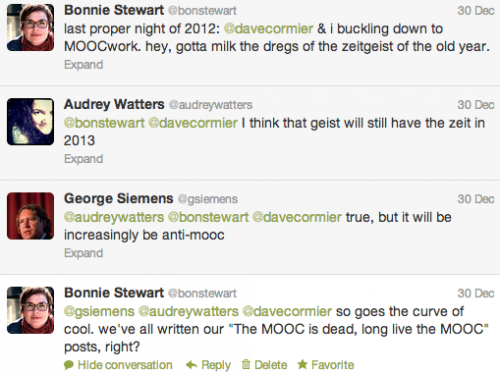
The night before New Year’s Eve, I joked on Twitter about Dave & I buckling down to work on the MOOCbook before the zeitgeist of the old year passed.

This morning I opened up my poor neglected blog and discovered the draft of this post, begun in July and last touched in late October, titled, in fact, “the MOOC is dead, long live the MOOC.” Apparently the joke is on me.

That’s the thing about MOOCs. They’re so everywhere that I can’t even keep track of what *I’ve* thought about them in the past couple of months, let alone the other copious buckets of ink spilled on the topic.

The whole damn thing has gotten so vast. And I feel as though it’s anathema to the current professional climate to ever admit one is overwhelmed, especially early in the new year, when one is supposed to be washed clean of all that baggage.

But there it is. Wherever you go, there you are.
***

Looking around at the broad higher ed/edtech scene, I suspect talking about MOOCs in productive ways is getting harder for everyone.

When there’s a clamour of voices, identifying the places and positions people are speaking from, let alone what’s left to be said, can be an assault from all directions. Trying to research MOOCs and write speculatively about what they may imply for higher ed is a lot like working in the midst of a big ol’ maelstrom. Mostly composed of verbiage.

Traditional models don’t suffice. Good research tends to try to be clear about which shoulders of giants it stands upon, and which gap in knowledge it aims to address. MOOCs are still such a moving target that the gaps in knowledge and direction aren’t really yet clear. And news reporting thrives on a heady mix of sensationalism and actual change, both of which are beginning to wear thin.

Because the biggest obstacle to effective conversation about MOOCs is that none of us IN the conversation – even the biggest names – appear to be clear yet on what MOOCs are or can be, or on where they begin and end.

As Dave put it in his inaugural appearance in ye olde fancy Wall Street Journal, “Nobody has any idea how it’s going to work.”

I’d go a step further, beyond the business model aspect of the conversation. I think the challenge with MOOCs, at this juncture, is that nobody has any idea what they are. This makes talking about what they *can be,* let alone their effects on what *is* in contemporary higher ed, rather a challenge.

Roger Whitson nailed it back in August after the first #MOOCMOOC experiment, with his Derridean claim of “il n’y a pas de hors-MOOC”  or There is no-outside MOOC; there is nothing outside the MOOC.

We *know* what we mean when we talk about higher education, or at least, we believe we do. We have a broadly agreed-upon societal understanding of where the perimeters of that conversation lie. In fact, the perimeters of that conversation have traditionally lain more or less where MOOCs begin.

But where do MOOCs end? If we are talking about experimentation with learning online, on any kind of mass scale, are we then talking about MOOCs? How do we distinguish one possibility from another?

A year ago, MOOCs themselves were a rather small experimental niche; a loose but vibrant network of learning focused around principles of connectivism and openness and distributed, generative knowledge. Then Sebastian Thrun opened up the AI course at Stanford: to those for whom MOOCs were familiar, the term fit.

George Siemens called the AI course a MOOC back in August, 2011. The media gradually caught up, because there was no other equivalent term. When Thrun founded Udacity and the hype began to build, the word “MOOC”  followed. And the rest, as they say, is history. Rather accidental history.

One of the most fascinating things about the proliferation of MOOC buzz is the way in which it’s made visible the networks by which media and higher ed make knowledge today.

But here we are, wherever we go. MOOCs mean video lectures. Or they mean distributed, aggregated means of making new knowledge. Or they mean democratization, or disruption, or whatever other Christ-on-the-cross people want to hang their futures on.

So how do we talk about the Internet happening to education without getting hopelessly mired in Wittgensteinian language-games? How do we begin to sort out and advocate for what we want MOOCs to be, when conversations about them tend to immediately point out that participants are speaking from entirely different reference points and hopes and belief systems?

I wish I knew.  That’d be a heady way to start the new year. Instead, all I know is too much is being conflated under this bubble, as if everybody just woke up and noticed the internet might actually be relevant to higher ed. In that sense, I almost hope the 2012 narrative around MOOCs *is* good and dead, much as I doubt the calendar shift simply erased it.

But I also know that this messy, paralytic conversation remains one of the liveliest things I’ve ever participated in professionally, in almost twenty years in the field of education. The idealist in me says that if we don’t know where MOOCs end, then maybe their possibilities are still grandly open.

For me personally, the value of MOOCs has been primarily in belonging: in finding ways to connect and learn and share within otherwise too-broad networks. In that spirit, then, I’ve signed up for two new (connectivist-style) MOOCs this month – #etmooc and the second #MOOCMOOC – in the midst of the book-writing and thesis-researching on the subject.  I’m hoping the more active engagement will help rejuvenate my own sense of the meta-conversation, and where to speak from.