grazing in the cloud

Slavoj Zizek’s recent article in Inside Higher Ed made me wonder whether my research should focus more on how corporate platforms affect social media users’ sense of their own capacities, and – by extension – identities. It also made me wonder if I’m not really a digital ungulate: a docile hoofed animal waiting to be herded.

That isn’t what the article’s about, exactly.

It’s about the cloud, or the preponderance of web-based tools and applications that make resources available to us via the internet and computing networks. The scope of power and access that the cloud makes available is enormous, far greater than most individuals would ever be able to afford, manage, or comprehend if we needed to coordinate or store stuff individually on our own machines. The cloud is a distributed delivery system on a grand scale.

And as many before Zizek have pointed out, it’s also a veil of abstraction that falls between the user and the technology; both cause and symptom of the increasing privatization of cyberspace. Because the gadgets we use are ever-more powerful and ever-more personalized, but they are also ever-more monopolized by a few corporations with particular commercial and ideological interests.

Now, I am a happy citizen of the cloud, most of the time. I don’t want to jail-break my iPhone; hell, I don’t even HAVE an iPhone. Even if I did, and someone was kind enough to jailbreak it for me, I wouldn’t know what to do with it. I don’t have the literacies. Sure, I spend perhaps eighty hours a week on my computer, and I possess a decent amount of meta-knowledge about social media and digital technologies and their implications for society. But I’m one of those people who came to the study of technologies through the door of cultural curiosity and theory. I started researching social technologies in 1997. It was only with the rise of social media and the cloud that I began to develop a practice – a deep practice, certainly, and deeply valuable to me – with social technologies.

That practice and its infiltration of my daily life and identity has made me profoundly dependent on platforms I don’t claim to understand. I am a social media animal, grazing in the cloud.

What I am not, no matter how extensive my interest in and usage of social technologies, is a geek. I use the term with props: my instinct is that I’d probably be better off a geek. Because geeks have a skillset and an agency with technologies that I do not. And part of what separates me and my ilk from the generation of digital enthusiasts before me – the generation who had to be, to some extent, geeks in order to invest as much of their lives and identities in digital technologies in a time when platforms did not make it all transparent for them – is captured in the distinction between geek and user.

I am a user and a thinker of digital technologies: I call myself a cyborg. But I do not have the agency a geek might have to control her own experience of the augmented reality of cyberspace. Twitter and Apple and Facebook and Google and Flickr pre-decide a great deal of that experience for me. And mostly I am happy with that, because I do not have the knowledge to make other decisions with, anyway.

Admittedly, I also don’t know how my car works, at any intimate level. But my social identity is not constructed in the interaction between my spark plugs and my engine. And so I wonder, as a social media animal, how corporate decisions about efficiency and profit and ease-of-use impact these seemingly endless capacities the cloud brings me? It appears to bring me new kinds of agency, and those are in, in effect, the subject of my doctoral research. But how is that agency constructed? What forms of control come with it?

Control, says Zizek, is one of the key hallmarks of this cloud culture. Vertical integration means that a single corporation is increasingly invested across multiple levels of the very huge business that is the cloud. As Zizek puts it, “Apple doesn’t only sell iPhones and iPads, it also owns iTunes. It also recently made a deal with Rupert Murdoch allowing the news on the Apple cloud to be supplied by Murdoch’s media empire.” (2011).

The cloud makes almost infinite access and choice available on one hand, while limiting other choices within the very narrow lines of corporate alliances. Most of us can’t and don’t want to make anything approaching an infinite number of choices. But when corporate alignments preclude even the rather reasonable and familiar choice of news providers, which most of us are more than capable of making, and then makes that choice appear natural to a digital citizenry conditioned to accepting what our platforms dictate…that seems like a problem.

It’s not a problem Slavoj Zizek has a solution for, unfortunately.

You can usually count on Zizek for a nice incisive polemic on contemporary culture, and for tearing sacred cows a new one as he goes. Sometimes he rises to the level of actually framing new perspectives on society’s comfortable habits. I studied with him for a summer back in 2004, and he was a magnetic, bear-like force who occasionally spat out tidbits that still churn in the pool of my thought-processes. At other times, I just got a lot of spit on me.

This piece on the cloud, though, left me almost spit-free. Sure, there’s a comparison between the cloud’s operations and those of the Chinese state, but otherwise, the article is almost…utterly rational. And observational in tone. It raises very few spectres, Chinese communism aside, and doesn’t mention Lacan once.

In the comments, there are tongue-in-cheek cries of “what have you done with Zizek?”

Shortly after a flurry of us tweeted the article out yesterday morning, Jim Groom noted similar concerns, asking, isn’t this rather tame for a cultural critic of his stature? Where, said Jim, are the alternatives to the problems Zizek identifies with cloud computing? And when, he said, will the poets of our moment emerge?

I wrote back a line from Ginsberg’s America: When can I go into the supermarket and buy what I need with my good looks?

It’s true, Zizek’s article largely failed to offer any sort of critical, mythical re-framing of possibility. And it’s true we could use a poet, or seven.

But maybe we’d do better with seven thousand. Maybe the problem isn’t solely the cloud, but the fact that our critical thinking skills are still set to a pre-cloud scale. Wrapping our minds around how the cloud changes things, and coming to any understanding of what the insidious corporatization of platforms means for identities and agency may take the kind of distributed, networked, crowdsourced effort the cloud makes possible. Maybe we need all the knowledges we can find.

Whether I look at social media from the perspective of individual subjectivities or the grand scale of the cloud, the issue of corporate symbiosis always crops up. How we understand who we are and what we do in contemporary culture – digital and otherwise – needs to account for the ways in which our social and learning environments and our ensuing identities are shaped by corporate decisions and practices and discourse. The scope and scale of this accounting is nearly as vast as that of the cloud itself.

Slavoj Zizek is a cultural critic of some stature, yes. But on cloud computing, he can only draw on what he knows, just as Jim Groom draws on what he knows, and I draw on what I know.  If Zizek had an answer, the chorus of blog posts that amplified his answer would each change it just a little, add something, create a composite narrative that might be better for the input of geeks, of poets, even of us ungulates.

How does the cloud impact you and what you can and can’t do? What control do you give over to the corporate wizards behind the curtain? What agency do you gain and/or lose? If you identify as a geek rather than an ungulate, would you recommend I stop merely grazing in the cloud, and start learning? What should I learn?

Tell me, all you poets and users and geeks. As Ginsberg said, queer shoulder to the wheel.


the augmented conference

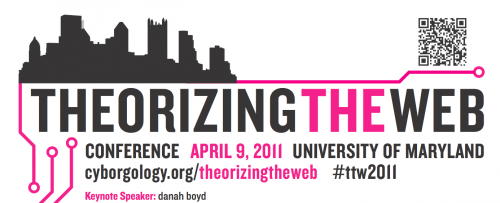
Theorizing the Web 2011 was a wicked conference. It was also a bit of a meta-experience in augmented reality.

Maybe not textbook augmented reality, admittedly, since – as happens at geek conferences – the sheer multitude of smart phones and laptops present overpowered the wireless system and the majority of us couldn’t get online much. I was disappointed that I couldn’t tweet a few of the presentations: one of the joys of digital participation is in turning a monologue into a forum, a conversation of sorts.

But there was plenty going on, even without much digital augmentation. Put together by PJ Rey & Nathan Jurgenson, grad students who set out to run the conference they wanted to go to, TtW2011 appeared to succeed beyond their wildest dreams. The day was jam-packed with sessions on new economies and cyber-racism and cyber-support and structure/agency and the question of social media revolutions, among others. The panels hung together, mostly, and people put work & energy into their presentations. Even the final sessions, which ran through what my parent-of-preschoolers brain has come to consider “suppertime,” played to engaged audiences.

That wasn’t the augmented reality part, though. Rather, the whole trip was. I marked my five-year blogging anniversary on Monday. And the trip to DC and College Park offered what for me – as the sole practicioner of social media in an Education cohort of three on an island half-way off the side of Canada – was a heady face-to-face tour through almost all corners of the connections I’ve made and learning I’ve done over that five years. I roomed with digiwonk, and sat in as she presented the results of a mommyblogging survey I participated in almost three years ago. I got to spend the day with Neilochka, who – as promised – didn’t call bullshit on me once. (At least not so I could hear him.) I listened to danah boyd’s keynote and complimented her on her boots, after citing her extensively in one of my term papers last fall. After all these years, I spent a glorious splashy rainy afternoon with Susan before the conference formally began. Through my panel I met fellow explorers into this messy, chewy business of cyborgs and mediated lives. I even met the real-life friend & colleague of someone I spent last week debating on Twitter. Tiny world. My apparently tiny digital world, all its interconnections brought to life in one short weekend.

The conference was the augmentation, for me, the extra. Back now in my pastoral cloister on the edge of the planet, this digital sphere is the one in which I seek the majority of my daily engagement with people over the age of five. Having them come to life in front of me reminded me of nothing so much as my first foray into Second Life, except without the difficulty walking and flying. TtW2011, for me, was proof not only that augmented reality really does exist, Virginia, but that there is no hierarchy of modes within it. All is interconnected, rhizomatically interwoven, ever-shifting and ever-surprising and ever-rich.
***
As for my presentation, I am still working on the art of clarity. I managed to pack a theoretically complex, 20 page paper into 15 minutes. Sorta. Here, in the slideshare below, I manage it in 10ish. I wish it were 5.

I’ve always been a literary storyteller…if I can teach myself through practice to become an effective didactic one, then I’ll be able to become the presenter I want to be. But there will be a lot of practice – a lot of reining in my natural tendency to go on and on, musingly – between now and then. Feedback welcome, and share at will.

for a very important date

In about ten days, I’m heading to a conference in College Park, Maryland. It’s being thrown by the editors of cyborgology, an exceptional resource site for all things social & technological, for hybrids and cyborgs of all stripes.

The conference is titled Theorizing the Web. The panel I’m on is titled Cyborgology: see the abstracts? Cool stuff.  The program? Augmented realities, counter-discourses, digital agency. I don’t get to have these conversations very often. And I’m rooming with an old blog friend whom I’ve never actually gotten to meet in person. So all in all, this will be good.

(It’s also pay-as-you-can. You should come.)

But there’s one hitch. My paper’s not quite done.

I’m doing a paper on theory work that will be the body of my dissertation. Some of the premises I’ve worked out, largely. But I’m still at the pre-proposal stage of my doctorate, so I’m writing this stuff for the first time. Which is good. And bad.

Writing, for me, is like a binge on the “Eat Me” cakes in Alice in Wonderland: it changes everything. I start somewhere and then I writhe in circles and dig up research and cringe horribly at my own naivete and spit stuff out anyway and then push and pull at words in a recursive fashion that sloths would call tedious. Stuff gets out there, eventually. But I learn more than I know how to say, how to cram together in a coherent trail. And I wish sometimes that it would just hurry up and get easier, this theory writing, this massive learning curve I’ve set ahead of myself like a ski jump.

I assume it does. I assume someday I’ll at least understand most of the grounding principals I’m working with, in this strange hybrid field of the social and the technological and the educational. But right now, every idea I eke out is a croquet game detouring into the bushes.

Someday, all this will not be novel. For me, for now, a lot of it still is. It’s slow-going, and I need to giddyup. But it is still the most interesting work I’ve ever done. I hope I can pull it together enough in the next ten days to do it justice.
***

Here is my abstract: the Coles notes. Input & critique welcome. Hurry.

The Branded Self: Cyborg Subjectivity in Social Media
My work takes up the question of who we are when we’re online. Participatory, reputation-focused online platforms such as Twitter, Facebook, and blogs allow people to perform their learning, their sociality and interests, their narrative histories and their minutiae in newly public, connected ways. The premise of my research is that these ongoing interactive performances open up new conceptions of self and subjectivity, and create new horizons and challenges within the field of education.

Donna Haraway called her original A Manifesto for Cyborgs (1991) an “ironic political myth”. In the late 20th century, she named the cyborg as our ontology, a representation of our societal and cultural politics. In reviving her cyborg for the era of social media, I explore its mythic potential for the relational and participatory knowledge-making sphere of social media, where new stories of self are told and reflected. With a deep bow to Haraway, my exploration of the branded cyborg subject aims to be an ironic educational myth for the 21st century.

I think of all of us using social media as branded selves, cyborgs whose online and offline lives blur. We are cyborgs because we are hybrids; because our “real lives” play out in part in cyberspace. We are branded because the cyberspace environment operates by branding – and socializing – all who enter: social, financial, and cultural capital are as central to the circulation of power and knowledge online today as the technologies and the human networks which form its infrastructure. The identities through which we connect with others and engage in the shared creation/consumption cycle that marks the social media economy are branded identities, even if we never monetize our brands.

Informal polls of cyborg subjects who live large portions of their lives online suggest that they generally consider their digital identities simply as extensions of themselves rather than as anything separate and distinct. I utilize Judith Butler’s notion of performativity to examine the constitution of subjectivities both online and off: those of us who become cyborg are always already subjects, yet the life that our stories and selves take on in cyberspace impacts our everyday lives in turn. Thus there is no dualistic divide between digital self and embodied self.

Nonetheless, the digital performance of identity warrants specific focus. The conventions and operations surrounding online interactions are not the same as in so-called “real life,” even when cyborg subjects try to conduct ourselves similarly across environments. The speed of connections, the different structures governing hierarchical relations, and the different conventions and etiquettes of online and offline life alter the subject positions that the environments create and privilege. The discursive field of social media – which my work posits as the site or stage on which the cyborg self performs and circulates – deviates from that of the broader culture. Some things are more speakable online than in real life, and the ways in which people interact and build knowledge within networks differs. My work treats our digital identities as offshoots of previously existing subjectivities, learning and engaging in augmented digital environments but always in a recursive relationship with our embodied selves.

why cyborgs are education

In writing my way through the drafts of what I hope will eventually be my dissertation proposal, I keep coming up against what appears to be a glaring absence, a hole in my work. When I talk about what I’m doing, the hole gets reflected back at me: politely but quizzically, a frequent “yes, but…” response.

The name of the hole is education.

I’m in a doctoral program in Educational Studies. I identify as an educator: I’ve been at this professionally since I was 22 years old. I’ve been a high school teacher and a special ed teacher and a travelling ESL professor and a sessional lecturer in academic writing. I’ve done educational project management and educational program development, written curriculum, designed rubrics. I’ve worn all kinds of different hats in my work life, but almost all of them have been in some sense or other education-related.

Then I enter a Ph.D in Education, and I stop.

What I’m writing about? Subjectivities. Cyborgs. Identity in social media. Technologies and reputation and social capital and cultural capital and money all circulating within social media networks, all of them shaping us just as we shape them by tweeting about our breakfasts. It’s big and messy and interesting and I haven’t even gotten to the part where I talk about knowledge or learning. It’s philosophy and sociology, with a nice smattering of psychoanalysis thrown in for good measure. I can’t blame anybody for asking where the education is.

It’s there, though, I’m convinced of it.

In the opening lines of The Cyborg Manifesto, Donna Haraway claims that her cyborg is faithful to its origins “as blasphemy is faithful” (1991, p. 149).  The next time somebody asks about my research’s location within the field of Educational Studies, I’m going to claim blasphemy. My research emphasizes – and critiques – the theoretical underpinnings of current educational practices, though its scope is not contained within notions of classroom or curriculum. And any work wherein education intersects with technology is vulnerable to visions of post-institutional worlds and DIY education. Yet as Haraway points out, “blasphemy has always seemed to require taking things very seriously” (191, p. 149). I have two children on the cusp of entering the public education system: there is not much I take so seriously.

Haraway called The Cyborg Manifesto “an ironic political myth” (1991, p. 149). I aim to make my exploration of the branded cyborg subject an ironic educational myth, one that visions possibilities for the public trust of education through a more detailed understanding of social media.
***

My almost five-year-old son did his first dinosaur podcast this past weekend, with his dad. Charlottetownosaurus, Episode One. Because if you are Oscar and you’ve been busily devouring all things dinosaur for almost two years now, you’ve accumulated a great deal of knowledge to share with the world. And because when you’ve accumulated knowledge or ideas or just plain passion for something, whatever it is, sharing it and getting feedback from other people on it? Matters. Even if you’re not yet five. He found out his babysitter listened to it and tweeted me about it and you would have thought he’d won an Academy Award.

He has been in full-time preschool now since September, in the daycare attached to the French school he will attend come next year. He went in with only a cursory vocabulary in French: now, he’s almost comfortable in the language. He’s certainly comfortable correcting my stilted Anglo pronunciations, and I grin at him and try again to match the sounds that suddenly, wonderfully, roll off his tongue.

His teacher’s experienced, and kind, and I think she’s good at what she does. But even after six+ months in a French class with only ten kids, this boy who’d happily eat and sleep dinosaurs all day long and has picked up five-syllable Latin terms just from having books read aloud to him still doesn’t know any dinosaur names in French. Nor the words for fairly familiar concepts like “herbivore” and “carnivore.”

Not a deal-breaker.  Not a personal criticism of his teacher, whose (underpaid) job it is to teach themes of seasons and foods and holidays, to organize and facilitate (rather beautiful) crafts with the kids, to read stories at circle time (which Oscar inevitably interrupts because he wants desperately to tell about the things he knows).

She is a good teacher. She makes homemade play-doh. He is learning from her.

But he is not learning that the things that drive him and the things that he can do are exciting and engaging, things to be built on. He’s not learning that his interests are valid or worthy of creative attention. He’s not learning how to participate in a produsage or prosumer world, where consumption and creation blur.

And that’s okay, I think. He’s not five. And he’s learning some of that stuff at home. And learning to take turns with the play-doh matters, absolutely.

But in terms of his subjectivity, his sense of himself in the world and the stories he belongs in, school – in this traditional model of learning to engage on externally-set terms – makes me a little sad.

He’s a pleaser and a connector, by nature. That’s where the interruptions at circle time come from, however misguided: he’s a kid who will offer up every last thought he can think of in hopes of gaining the engagement and attention of another human being. When that happens, and a positive reflection of himself shines back at him, his world’s complete.

We all need to learn to deal with our worlds not being complete all the time. I work hard with Oscar on a daily basis to help him see – and seize – moments when others might be open to engaging, and when they’re just busy with the damn dishes and getting him a glass of milk, thank you very much.

But humans who need to connect aren’t well-served by systems that externalize what happens to us, that are structured to emphasize compliance and passivity over the scramble to share all the wonders that flit through our brains. It is human to clamour, but it is particularly hard to pay attention to clamour in systems where the audience for the clamour is smaller than the number of clamourers. School is an anti-clamour system at least in part because there are almost always more students than teachers, and human engagement does not thrive in that climate of division, nor on demand.

Human engagement can survive division, however, if it is not required to physically respond to multiple demands at once. Particularly if it has some agency over what it engages with. Clamour, I would argue, is alive and well.

It’s online, in social media.

My Twitter feed is full of people scrambling to share the wonders flitting across their brains. I learn from some of it. I am moved by some. I tune some out – but I don’t need to hush anyone for demanding anything of me, because they’re not. They’re just putting their stuff out there, in a forum where others can engage or attend if they want. That kid who was always waving his hand around in preschool circle time, the one the teacher probably wanted to throttle? He may have grown up to be one of the richest resources out there in his field, connecting and sharing and repackaging what he knows, just in case you want to know too.

He’s a cyborg, and social media is the world’s biggest circle time.

And so that gap between my emerging dissertation and education? I don’t think it’s there. I have a lot of work ahead of me to try to understand what it means, subjectivity-wise, to engage and live and learn in the clamour, but I hope eventually to be able to show that the clamour is not the enemy of learning, only of a model of schooling which need not be the alpha and omega of the field of education.

That would be an ironic educational myth, indeed.


the man who sold the world

We passed upon the stair, we spoke in was and when
Although I wasn’t there, he said I was his friend

– David Bowie, The Man Who Sold The World, 1970

(Of course Bowie makes me think about identity.)

I need a word.

A year or so ago, long before I started this theoryblog lean-to on the side of ye olde cribchronicles, I started groping my way towards exploring something, trying to capture something I’d never heard named. I assumed it had been named, somewhere, probably a few times over, but was both amorphous enough and fast-moving enough to have refused reification, mass currency under a single title.

I called it brand, half tongue-in-cheek. I’ve always found brand a vulgar word, flagrant and blatant in its commercial intent. The online universe – especially in the education and narrative blog circles I run in – is not always so open about its own embeddedness in the capital exchange process. I chose the word to provoke, to try to force that conversation.

But mostly I chose it to keep me honest.

It forced me to look at my commercially lilywhite self and own that I am as embroiled and invested in online circulations of capital and power as the trashiest review pimp out there. Because you cannot use social media and not be embroiled. As you connect and share and have your work recognized by others, your social capital is amplified. As your social capital is amplified, your capacity to leverage it increases, often exponentially. You don’t have to: the monetization of the sphere is not obligatory. But ignoring it doesn’t mean it’s gone away.

I wrote three posts in quick succession on the subject. In the last one, I said it like this:

be it beauty or ideas or humour, it matters not. if you put it out
there and it works, it builds reputation. reputation can be leveraged,
sometimes into capital, sometimes into opportunity, sometimes
simply  into connection. we all have our eyes on a prize; we are
none of us pure, without want.

branding is what is read on to you, how you are perceived, what
you signify in the eyes of everybody else. it is not you, but a version
of you. it is an act, and a group act, one that does not exist without
a network of some sort to reflect and amplify it. it is ephemeral, a
wisp on the wind. it is not about content or truth.

it is about image and perceived capacity.
(own it, cribchronicles.com, June 8th, 2010)

I think of all of us out here using social media in our myriad of ways as branded selves, branded cyborgs whose online and offline lives blur. Within the walls of the academy, where the branded cyborg is my dissertation topic, I tend to use the words digital identity or digital subjectivity to describe the idea, depending on which discipline I’m addressing. I see them all tied together in Butler’s idea of the performative: that subjectivities are created by the constant and ongoing citation of the (gendered) societal norms that circulate in discourse. What makes me different from you is how I perform myself – online or off – in relation to those norms.

And what makes me a branded cyborg is that the circulations in which I reference and identify myself include the spheres of social media and concommittant capital. And some version of me – my brand, or my digital identity – continues on performing me in circulation even when I’m not there. Ahem. That’s all. But that’s not an easy thing to explain.

It’s hard to name a social aggregate, an “it” in circulation. As Bruno LaTour puts it in Reassembling the Social, “…Social aggregates are not the object of an ostensive definition – like mugs and cats and chairs that can be pointed at by the index finger – but only of a performative definition. They are made by the various ways and manners in which they are said to exist” (p. 34).  The performative definition of a group draws attention to the means necessary to keep it up, and also to the contributions made by the fact of it being studied or analyzed.

Goody. I need a word to cover the performative definition of performativity in the world of social media.

Amber Case (here at TEDWomen) is a cyborg anthroplogist, which basically means she studies human life as a product of humans and technologies, or objects. She calls the ephemeral us-ness that others interact with online our “second self.”

I’m wary of this term. The idea of a second self ignores the fact that the identity distinctions between online and offline life are increasingly minimal and blurred and often meaningless: tomorrow, for instance, I’ll travel to another province to hang out with a bunch of bloggers, word made flesh. The transition from screen narratives and flurries of Twitter conversation to clinking glasses will not be particularly jarring: in fact, because the group of us interact far more regularly than most of us do with friends we know only in the flesh, the awkward stage of polite catching up will be largely bypassed. We are intimate, because we are regularly online together. Are you listening, Sherry Turkle?

Nathan Jurgenson of cyborgology – who adeptly critiques the binary implicated in the second self idea here – calls it a Profile, an aggregate sum of all the data out there about you. I think we’re on the same page conceptually. There’s something fluid about the word: its connotations are less laden than that of brand, or identity. Yet to me it suggests something flat, surface-like, easily tied up. Does it allow for complex performances of digital identity? Does it represent who we are when we’re not there?

I need to talk this out. Last time I asked – when I asked who you think you are online – I got an extraordinary collection of responses and discussion. This is part two, the simpler question, really: what would you call this you I know out here, your online doppelganger, your disembodied you? Profile, brand, second self, digital identity…what works?