learning to unlearn: building networked identities in education

In a little less than two weeks time, I’m facilitating a week-long discussion/overview/ exploration on “Building a Networked Identity: Becoming a Connected Educator” as part of the #wweopen13 MOOC-ish course on Online Instruction for Open Educators.

I say MOOC-ish because the term has become so fraught lately I’m not even sure what people conjure up when they hear it. Insidious corporate encroachment and consolidation of Big Ed interests? Yep, that’s definitely under the big MOOC tent. Something interesting to do? That’s there too. A learning structure not entirely given over to the logics and informatics of domination? Depends entirely on the model.

(Note: there is a difference between what MOOCs in their many incarnations actually bring to the education conversation and what they’re sold as bringing. A revolutionary solution for educating society? Please, no. That’s just PR and the fantasy of free market education, not something any MOOC has any business claiming. Even if they insist on claiming it. There are things MOOCs are good for, and then there’s the hype cycle. Caveat emptor.)
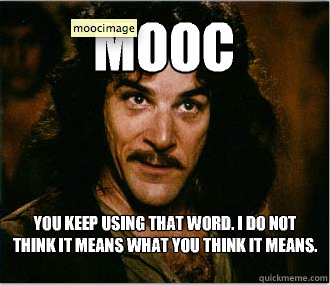
Screen shot 2013-10-29 at 3.43.20 PM

Image by Aaron Bady

Anyhoo. Like George Veletsianos says in his slides from last week’s COHERE 2013 conference, MOOCs represent something broader than any of the courses – or even the platforms – themselves: they’re a phenomenon, a symptom of the many chronic issues and narratives intersecting in education at this juncture. Enter #wweopen13, which ironically isn’t quite as open as it might like to be, bound as it is to a D2L LMS platform for this iteration. I’m trying to mitigate some of that platform constraint by doing my thinking aloud for the course here, before my week gets started. Because in a sense, I think the conversation about becoming a networked educator needs to be – at least in part – a truly public conversation, one where random connections can be made and the scope and scale of the discussion isn’t limited by membership on a class list, even if that class list is free to sign up for.

Which doesn’t mean I don’t want you to sign up: we’d LOVE to have you, even if only for the one week. Or all four remaining…it’s never too late. This week, Jenni Hayman & Sean Gallagher take you on a Tour of Technology. Next week, that Dave Cormier guy is going to go on about Community and Curriculum. It’ll be jolly. And any ideas and experiences you share here will effectively become part of the course conversation for the week I’m teaching, whether you make the leap into the course itself or no.
***
Connected Educator = An Identity
You’ll notice I’m talking about conversations. If you landed here hoping for a tidy list of failsafe takeaways for how to become a connected educator, mine’s disappointingly short. It goes something like this:

Step #1: um, talk to people. Online, offline…network with people who are interesting and interested in stuff you find interesting. Learn. Grow.

That’s it.

The whole week is designed around two things: the first is a meta-exploration of networked identities, or the implications of being a connected educator, especially in the online context. We’ll talk about different aspects of digital identities, and about how digitally-networked identities differ in structure and possibility from institutional identities. The second thing we’ll do is try to put some of those explorations into practice, with activities focused on your own profiles and networks.

*If* you want to. It’s a MOOC. There’s no grade, participation is voluntary, and you have the agency to decide what you want to do, and what you don’t. You may already be doing most of it, or connecting just fine offline and that’s enough for you, thankyouverymuch, and that’s all good by me. A vein of almost-evangelism about online connectedness has popped up, especially in the K-12 ed circuit, where people are sometimes made to feel as if they *have* to network online in order to be an effective, active, growing educator, and I don’t entirely believe that. I do think online connectedness can offer real value, and part of my focus during the #wweopen13 week will be on what that value is and how it differs from being connected offline. But you can take big or small or zero steps in that direction during our week: up to you. Just being part of the conversation – even about why you don’t want to network online in a professional capacity – is welcome.

How Networks Change Online Education
Because in a course on open online teaching, it’s important for me to emphasize that the open, networked side of online practice is different from just teaching via computer: networked activities can affect the pedagogy and power structures of your classes.

As Stephen Downes has been saying for years, there are key differences between groups and networks, and one is that groups are collections based on some property or commonality (welcome to kindergarten, all children born in 20o8!) whereas a network is an association. In associations, connections are more voluntary, but they also require visible signalling in order to occur. In a classroom, you can sit quietly all year and to some extent, you are nonetheless part of the group: visible, even if by your non-participation. In online networks in particular, non-participation does not signal. You need to make yourself visible in order to form connections; to become part of the association.

I research networked practices, or the ways people signal their participation. My work in online ed wasn’t always networked, though: I started in this field back in the early days, from 1998-2000, and have taught online and blended courses in a variety of higher ed settings since 2002. I’ve worked with and on platforms like Jones that don’t exist anymore, and on WebCT, Blackboard, Moodle, Canvas, and now D2L. I think a lot of valuable education can occur within the bounds of an LMS, just as it can occur within the bounds of a classroom…and both classroom and LMS spaces can provide what some learners experience as a safer, more supportive jumping-off point for learning than the cacophony and exposure of public conversation.

But. Habits and roles around education are learned early and deeply, and the line between safety and learned passivity can be hard to challenge, particularly in an online environment. The design and affordances of most LMS spaces parse conversation into discrete, digestible chunks that are teacher-controlled and linear, encouraging behaviours and practices that replicate traditional transmission-style education, or what Freire called the banking model. Even – and this is important – if that’s no one’s intent.

So if your vision of education is one of higher order thinking and open-ended inquiry and participatory networked connections, working entirely within a closed LMS isn’t necessarily optimal.

Which is where networks can certainly help. Networked learning means not just opening up the walls of the classroom to enable connection with those outside – Twitter discussions with authors being read, for example, or public posting of questions for input from students and whoever else is interested – but also reconfiguring the idea and power relations of the classroom itself. As George Siemens points out in this slideshow, the architecture of networked information is distributed, scalable, self-organizing and adaptive: it has no centre. So networked courses create temporary centres around it, but also leave the possibility of multiple rabbit holes and open-ended inquiries and meaningful connections open, ideally. More importantly, when the networking takes place using platforms participants already use in their daily lives, you create the opportunity for ongoing connection and learning long after the temporary centre of the course is finished.

Still, networked learning is messy. It requires a great deal of leadership and support from teachers/facilitators. It requires UNlearning, for teachers and students. And that unlearning has to take place at the identity level.

Networked Identities Begin with Unlearning
Participating in a networked learning environment involves confronting and smacking down ten or twenty years of implicit and internalized messages that tend to run a bit like this: Raise your hand, Bonnie. Stay on task, Bonnie. That book in your lap is NOT your math assignment, Bonnie. Please stop talking to your neighbour, Bonnie. Speak when you’re spoken to, Bonnie.

Image from https://dx5y3z85enc4t.cloudfront.net/540×540/fit/hostedimages/1380336007/694597.jpg

Ahem.

Now, those are not the only identity messages education teaches, at least if we’re lucky. I’ve had a great many wonderful teachers who’ve connected with me, been patient with me, altered my trajectories and fostered my gifts. But education is a system and tacitly, it systematizes us, even if it manages to exhort us to more. And when we hit networked learning environments, especially if they’re massive and open, those systematized identities can be an albatross.

Because in a networked environment, the contained one-to-many teacher-student relationship and responsibility which is the driving logic behind most of those systematizing practices (that, and the traditional role of teacher as knower) no longer operates. There’s no sense of where belonging to a given conversation begins and ends. For those of us who’ve internalized the “speak only when you’re called upon” message, the slow, painful, eventual realization is this: there is no one standing at the proverbial front of the class to validate our inner Lisa Simpson when she politely waves her hand. Waiting quietly to join in does not signal.

Likewise, from a teaching perspective, assuming everyone can and will just leap in and join the conversation doesn’t help foster any kind of real opportunities for participation for those who might struggle. We are all different, and some of us are used to being heard more than others. The old adage says “on the Internet nobody knows you’re a dog,” but that’s perhaps only because there’s no way to see who sits on cue. Our gendered, raced, classed embodied selves – who all fall along varying spectra of sexual orientation and gender performance and neurotypicality and ability AND whose ways of signalling identity and reading signals in conversation come from the experiences we’ve been accustomed to having in those respective bodies – shape the kinds of signalling and participating we’re comfortable doing. So…online is not the great leveller. Power relations manifest differently, but they’re still there. And thus teaching as a connected educator not only involves trying to create opportunities for people to participate or signal that they want to participate, but also being aware of power imbalances, modelling attentiveness, and trying to find backchannel ways of helping people feel as included as possible. Especially if conversation is your goal.
***

As a sort of trailer for my upcoming week with #wweopen13, I’d like to end this intro to networked identities in educational spaces by asking you – whether you’re in the course or wouldn’t be caught dead there, whether you have an online network of 3 or 30,000 – what YOUR experiences have been with networks, in or out of education, good or bad.

What are your stories? What are the risks? The joys? The things you think people should consider before embarking on this path of opening up the walls surrounding teacher & student identities?

And if you’re in the course or *thinking* of being a part of it…don’t worry. There won’t be any other invitations to do homework in advance. ;)


in which i discover my field AND its identity crisis all at once

First, the good news.

Last week, I submitted my 42 page thesis proposal, take 2. Once I get the feedback from my committee incorporated and I scour the whole thing clean of APA atrocities, I’ll post it here for your collective input (or your gladiatorial thumping). I promise.

After submitting, I promptly packed my bags and ran off to the salt shores of Nova Scotia to present my research at the friendly and thought-provoking Social Media and Society ’13 conference (in the midst of which I ran further off to the backwoods to sleep in a shed by a creek with a bunch of banjo-loving photographers I first met online years ago…because hey, banjos and bonfires are a known remedy for the marathon aches and angst acquired during proposal journeys).

What I presented at #SMSociety13 was this: 15 minutes, 15 slides, on the ethnography I propose for my dissertation study.

I opened the presentation by asking how many in the room of perhaps close to 100 were live-tweeting the session under their own names: a fair majority raised their hands. I asked how many also had some kind of academic or institutional affiliation using those same names. Still a majority.

I said, “So…I don’t want to make anyone uncomfortable…but I’M TALKING ABOUT YOU, here”.

Nobody ran away, gentle reader. These were my people: networked scholars, ready to hear about my work and engage with it publicly, in the moment: to build an ephemeral yet traceable public conversation around it.

I opened by confessing that the title of my presentation is – from the perspective of most networked scholars – a lie. The idea that there’s a Star Wars-style epic battle raging between the forces of networks and institutions is a false binary. Truth is, most of us who’ve made thinking out loud online a central part of our scholarship also have a foot in the world of conventional, institutional academic practices too…because those are the practices hiring committees recognize and the majority of us like to eat and stuff. So I’m poking fun at my own reinforcement of the binary in my choice of font, here.

But. The binary is also a very helpful expository device, especially if one’s audience is not entirely comprised of networked scholars. Networked practices are immersive, and difficult for those without experience of them to even imagine. So much of conventional scholarly practice is about citation of norms that even talking about networked practices as scholarship doesn’t compute for many folks: hence my extensive use, this last six months, of various versions of the comparative Institutions/Networks slide found in the middle of this presentation. The comparison is meant to make visible the familiar logics of conventional scholarship as well as those emerging in participatory networks.

There’s huge overlap: as I point out in slide 3, both academia and networks are reputational economies. But it’s the distinctions – the ethos and specific practices by which networked scholars build ties and reputations and conversations and leverage these into forms of capital that aren’t always financial – that interest me. My hope is that mapped against the familiar terrain of institutional practices, networked practices become intelligible and visible. Not necessarily legitimated – that’s a separate step. But the academy cannot begin to think about whether the practices of networked scholars are legitimate if it cannot even see them and the logics that drive them.

Networked practices excite me. Three years into this Ph.D and more than three years after I started exploring the idea of networks and branding out loud on my old blog, I think I finally understand what I’m doing. Not as a researcher, necessarily, and certainly not as an academic – I have a lot to learn – but as a thinker. At the end of all my roads of exploration – the common thread running through my work on brand and identities and cyborgs and MOOCs – the Rome I keep coming back to is networked practices, or what we do when we’re out here online in participatory spaces. Specifically, it’s networked practices as identity work: the ways in which networks shape the performative practices by which we shape how we are seen…and, I will argue, who we are.

Yay.

***

And then there’s the bad news.

I woke up yesterday and realized I haven’t posted here since June. Which is okay – I had a thesis proposal to write and kids home with me five weeks of the summer. But I didn’t particularly feel as if I’d fallen off the face of the earth.

Which means the very networked practices I’ve just settled on and built a proposal about are shifting. I suspect the whole political economy that underlies them is shifting…or as some would frame it, depending on their perspective, “maturing.” The “media” in social media is increasingly in ascendancy over the social…though again, the idea that the two are a binary is false. Still, this field of study I’ve just settled on? Seems about to hit an identity crisis.

The “Web 2.0” era definitions of networked participation no longer effectively describe dominant practice.

I have STELLAR timing, people.

It used to be if I went so much as a couple of weeks without a blog post, I felt transgressive. Not because my voice is any special snowflake, but because speaking – contributing – has always been the price of admission into the conversation out here in the open networks in which I’ve circulated. No matter the circles – momblogosphere, narrative writing, Edtech – the practices have been broadly the same, and broadly reciprocal. Whenever I slipped away from the habit of contributing, I tended to feel as if I owed my readership an opening act of contrition…because even if that readership was numerically small, it constituted what boyd (2010) calls a “networked public:” both a space created by networked technologies and the imagined collective emerging from the intersections of people, technologies, and practice. And our practices were based in produsage (Bruns, 2007), in establishing voice and identity within the reciprocal production/consumption cycle.

I think produsage still operates, but what counts as production or contribution is shifting…minimizing. The filtering and re-sharing of others’ work – commonly called “curation” to the endless grief of librarians and art specialists everywhere – has become the base price of admission: as more people join participatory circles, voices and identities are established via signals that take less time to both craft and to assess. Blog posts are not necessary, and in fact, unless they come under the banner of a major media consortium, may not even have cache: produsage is being sped up, these days. Reputations and identities need to be established on terms that require less investment.

They’re still relational, I maintain – we still read and assess signals from each other about credibility and status and whether we like jellybeans or potato chips – but as scale increases, recognizable reputations carry more power to signal. They are the only ones most of us can differentiate from the noise. Thus, the reversion to major media channels rather than a truly peer-to-peer production model. In this sense, I wonder whether our networked practices – our habits of use and the ways in which we connect and signal – aren’t also becoming increasingly reflective of society’s inequities, bringing more attention and more capital – financial, social, even symbolic – to those who start from a position of scale.

Or that’s what I wonder and worry about. But data collection is yet ahead of me! Stay tuned…and please, throw in. What do YOU think is up with networks and participation, these days? If you’ve been around awhile, do you see a shift?


from scratch: a dissertation research problem, take two

I haven’t had much to say here lately about my, erm, thesis. I started this blog back in 2011 to try to work through the process in the open, but complexity and uncertainty and the MOOC book – which is still chugging along through various stages of labour – seem to have gotten the better of me over the past couple of semesters.

That, or I finally started listening to mother’s advice, in the “if you can’t say anything nice…” vein. The whole, “here, this is a dog’s breakfast! Please enjoy!” line seldom hooks a readership, unless they’re compulsive editors or have an excessive empathy drive. Or are procrastinating on their own writing (welcome!)

I did write an 80 page thesis proposal, as part of my comps portfolio last December. I passed (woot!), and became an official Ph.D candidate. But in the process it became clear that I’d bitten off about half the Internet as subject matter and wasn’t clear on how to focus the scale of the project to, um, do-able.

Do-able is, of course, the key to that magic future perfect (in the grammatic sense) state of “done.” So after much thinking and reading and talking with my advisors, I’ve skinned the scope and scale of the thesis down and am starting the proposal again. From scratch.

And I’m asking for input. Your eyes. Your suggestions. Your thoughts about potential participants. Your sympathies gin.

My introduction and “research problem” for the new proposal are below. What they begin to lay out will be an ethnography: a form of qualitative research that explores cultural phenomena and meanings and patterns from participants’ viewpoints, making visible what might otherwise be invisible to those outside the culture.

Or that’s the plan.

The culture under investigation here is one to which this blog is a (tiny) contributor: the public participatory sphere of scholarly networks. This subculture of the broader phenomenon of participatory culture spans Twitter and blogs and G+ and even major media spaces, but also runs parallel, in a sense, to institutional academia: the participants I study will all have a foot in both worlds, and the goal of the research is to make the operations and practices of the online sphere visible and intelligible to scholars (and the public) outside it. So I’m looking at digitally-networked practices and identities, as ever, but rather than beginning from a theoretical framework of the cyborg to which my data (ie participants) would need to conform, I’m starting instead from practice and experience.

Basically, I’m looking for and at academics and grad students and others all along the continuum of scholarship. I’m looking at the ways we build identities and reputations for our ideas outside of – but often in tandem with – accepted academic practices like publishing in refereed journals or climbing the tenure track ladder, particularly since that ladder has come to look a bit like Brigadoon for many within the ranks of adjuncts and graduate programs lately.

I’m drawing heavily here on the work of George Veletsianos and Royce Kimmons, who’ve been writing about Networked Participatory Scholarship (2011) for a couple of years now. I’m narrowing the focus of that concept by looking not just at the online participatory work of scholars, but specifically at the work of scholars for whom a significant portion of work and thinking and reputation-building occurs online. Using Dave White & Alison LeCornu’s (2011) visitors and residents model, I’m looking at resident online scholars, engaged in the kind of merged production/consumption Bruns (2008) calls produsage and Ritzer and Jurgenson (2010, with particular focus on unpaid labour in the context of abundance) term prosumption. In the intersection between residents, prosumption, and networked participatory scholarship, you have what I’m calling networked scholarly participation, or the subset of participatory culture that intersects with academia. I’m also drawing on the work Cristina Costa did in her recent dissertation on the participatory web’s relationship to academic research, though my study will focus less on research and more on reputation and identities development. the work of danah boyd and others on networked publics and the New London group’s literacies and new media literacies will frame my approach to what it means to work in public.

But there’s always more out there.

Being an open, networked teacher/learner/scholar means asking, “Hey, does this make sense? Is it silly? Is someone already doing it? How can I improve?” EVERY SINGLE TIME you put your work out there. It’s intimidating. I always forget, until that moment right before I hit “publish.”

But it also means getting answers to those questions while the work is still in progress, taking shape, and that is immensely helpful. So here goes. Take two on my thesis research problem, a draft, needing your eyes.

Does this make sense? Is it silly? Would you participate?

I’m all ears.
:)
Bon

Introduction:
Over the last decade, the ways in which people can to connect with one another and share ideas online have multiplied dramatically. Social network platforms such as Facebook and Twitter have become commonplace means of communication and interaction. The proliferation of free blogging platforms such as WordPress, Blogger, and Tumblr has enabled unprecedented self-publishing, and the rise of camera-enabled phones combined with platforms such as Youtube and Instagram has meant that images and videos can be freely shared as well. Participation in public conversations via the Internet has become a feature of contemporary life.

Many forms of online participation are becoming visible within contemporary academia, as well. Since the first computer-based courses in the 1980s (Mason 2005), learning management systems such as Blackboard and Moodle have been widely adopted by institutions in many countries, enabling both fully online and hybrid or blended courses, which combine face-to-face facilitation with supplemental online engagement. Pressure on institutions to deliver courses online has risen recently as Massive Open Online Courses (MOOCs) have become a buzzword across higher education: the New York Times went so far as to dub 2012 the ‘Year of the MOOC’ (Pappano, 2012).

The proliferation of online learning in higher education, however, goes far beyond the rise of online and hybrid classes and formal learning opportunities. The phenomenon of participatory culture (Jenkins, 2006) has begun to permeate higher education. Scholars themselves are going beyond teaching and searching online to building public bodies of work via participatory media; self-publishing, sharing ideas via multiple platforms, and engaging with emergent issues in higher education and society at large. Within this public, participatory intellectual sphere, networks of scholars and emerging scholars develop across multiple technological platforms, engaging with each other and each other’s work regularly. These networks of participation and collaboration may extend beyond online communications to face-to-face contacts if geographic limitations allow.

There are myriad platforms available for open scholarly networking, many with their own particular purpose. Social networking sites (SNS) such as Academia.edu have emerged specifically for scholars, while reference management tools such as Zotero and Mendeley have gradually integrated networking capacities for scholars to recommend, share, and tag resources. Twitter is a general but immensely adaptable platform: hashtags such as #highered, #cdnpse (Canadian post-secondary education), and #phdchat aggregate input from interested parties all over the world. Google hangouts are utilized to host informal open discussions and learning experiences, and Facebook groups focused around specific disciplinary and research interests enable real-time public discussion of issues and ideas. Nor are SNS the only means by which scholars connect and share their ideas: major media outlets and higher education news forums host blogs that amplify scholars’ opinions and voices; many academics share their own emerging ideas and observations via active independent blogs.

These networked practices not only connect scholars to each other across disciplinary lines; they open access to discussions that have traditionally occurred within more closed and formalized channels. Participatory scholarly networks therefore create new opportunities for public engagement with ideas (Weller, 2012) and can offer junior scholars and graduate students opportunities alternate channels for participation, leadership, and development of scholarly reputations. They can serve as communities of practice (Lave and Wenger, 1990) and informal learning communities for scholars, and foster what Lankshear and Knobel (2007) call “new literacies,” or an ethos of “mass participation, distributed expertise, valid and rewardable roles for all who pitch in” (p. 18).

This ethos and practice of mass participation, however, does not align entirely with the institutionalized traditions and operations of academia. As Daniels (2013) notes, in her discussion of “legacy” (pre 21st century) model journalism and its implications for higher education, “We have our own “legacy” model of academic scholarship with distinct characteristics…analog, closed, removed from the public sphere, and monastic” (Legacy academic scholarship section, para. 3). While Daniels acknowledges that this legacy model is not necessarily as dominant or closed as it once was, she notes its retreat is partial and piecemeal (Legacy academic scholarship section, para. 2). There can be hesitation among academics about the risks involved in developing an online presence (King & Hargittai 2013) and sharing intellectual property. Some of the practices and identity roles cultivated via participation can appear transgressive or inconsequential when viewed through the lens of the academy.

The goal of this proposed dissertation research is to make visible how those same practices and identities appear when viewed through the lens of new literacies and mass participation. The work of Veletsianos (2011) and Veletsianos and Kimmons (2012, 2013) frames such practices as ‘networked participatory scholarship’ (Veletsianos, 2011). Defined as “scholars’ participation in online social networks to share, reflect upon, critique, improve, validate, and otherwise develop their scholarship,” (Veletsianos and Kimmons, 2012), networked participatory scholarship is a framework that invites inquiry into the relationship between technology and scholarly practice, and into the techno-cultural pressures surrounding the use of digital technologies in academia. Networked participatory scholarship centres on individual scholars’ participatory engagement with digital technologies, and also on the effects of participation on scholarly practice. Its definition of scholar refers to any “individuals who participate in teaching and/or research endeavours (e.g., doctoral students, faculty members, instructors, and researchers)” (Veletsianos and Kimmons, 2012, para. 2).

This proposed dissertation project will build on the concept of networked participatory scholarship in designing an ethnographic study of networked scholars, but will focus specifically on scholars whose networked participation is a central, sustained aspect of their scholarly work, identity, and reputation development. The study will therefore expand the literature on networked participatory scholarship while also narrowing the focus of the concept to a particular practice and group of practitioners as a subset of participatory culture. The project will re-frame this specific focus of study as networked scholarly participation.

In order to facilitate this re-framing, I intend to bring networked participatory scholarship into conversation with two other key frameworks related to online networked practices. The first of this is White and LeCornu’s (2011) visitors and residents typology for online engagement, which offers a means of framing participation and participatory buy-in beyond Prensky’s (2001) much-critiqued “digital natives” model; this study will focus, effectively, on what White and LeCornu call residents, or regular, active users. Second, the study will focus on scholars for whom networked participation involves ongoing production and sharing of ideas and resources related to their own scholarly inquiries. This demarcation is drawn from Bruns’ (2008) concept of a produsage economy, in which production and consumption are collapsed and combined via the interconnectedness of online networks and their capacity to create reciprocal audiences. Ritzer and Jurgenson’s (2010) notion of prosumption further contextualizes the combination of production and consumption into a prosumption model that takes into account societal trends towards abundance and unpaid labour.

Ultimately, then, the practices under investigation in this study will be those of scholars actively developing and sustaining a networked participatory identity and reputation while simultaneously engaged in institutional scholarly work.

Research Problem:
Both academia and social media can be said to be ‘reputational economies’ (Willinksy, 2010; Hearn, 2010), but the terms of entry and access for each are different, as are some of the values and practices upon which reputations are built.

For scholars active within participatory networks, this can mean navigating two sets of expectations, legitimacy standards, and concepts of success at the same time, as well as negotiating institutional relationships with peers, superiors, and students for whom the participatory set of terms may be invisible or devalued.

This dissertation project will focus on making the terms of credibility and reputational value within participatory scholarly networks visible. The study will investigate the ways in which online networks open up identity and reputation spaces that may not otherwise be available. It will trace both distinctions and commonalities in the ways institutions and networks foster identities and reputations, from the perspectives of scholars who actively straddle both worlds.

Online networked participation demands the construction, performance and curation of sustained, intelligible public identities. There is no formalized route or guide for this process, nor a clear distinguishing point between non-engagement and engagement in the process. Whether one is an outsider, an insider, or somewhere between cannot always be clearly identified, particularly from an external viewpoint. Networks tend to be distributed and fluid entities, wherein “membership is mostly unrestricted and participants may know some but not all members of the network” (Dron and Anderson, 2009, section 4.2, Amongst scholars, para. 6). Participants, therefore, self-select into the cumulative and ongoing realm of networked belonging and reputation-building.

Academic belonging, on the other hand, is more overtly restricted and codified: identity roles such as ‘graduate student,’ ‘associate professor,’ and ‘adjunct’ have widely-understood meanings and criteria for belonging. An academic reputation requires clear membership within the hierarchic institution of the academy, through the completion of an advanced degree and, usually, the securing of a tenure track position. Within the tenure model, success is incremental and reputation tied at least in part to clear externalized achievements:

Those who work within the academy become very skilled at judging
the stuff of reputations. Where has the person’s work been published,
what claims of priority in discovery have they established, how often
have they been cited, how and where reviewed, what prizes won,
what institutional ties earned, what organizations led?
(Willinsky, 2010, p. 297)

In both online and formal academic spheres, reputations are also dependent on relational ineffables such as social capital (Bourdieu, 1984), and the goodwill and esteem of peers. These and other commonalities will be included in the study. But the premise of this research is that the terms on which reputations are built, enhanced and taken up within the ethos of mass participation exemplified by scholarly online networks demand specific attention and articulation.

This dissertation proposal, then, proposes an ethnographic exploration of participatory scholarly networks. Its intent is to conduct a sustained ethnographic investigation into the ways scholarly practices and identities are shaped, enabled and constrained by online participatory networks. The study will investigate the ways in which scholars enact and experience scholarly engagement, research and research dissemination, and reputation-building within participatory online networks. It will attempt to make visible both overlaps and differences between these practices and those experienced within institutional contexts. Distinctions will be framed both in terms of the differing affordances of online and offline interactions and between what the literature frames as the differing mindsets (Barlow, 1995, in an interview with Tunbridge) or paradigms shaping physical space and cyberspace.

What do these participatory networks offer scholars? What – if anything – is their value and advantage over more conventional forms of scholarly networking, such as that which occurs at academic conferences and symposia? What do they offer over established forms of idea sharing and reputation development? What are their disadvantages? In what ways are they complementary? These questions will form the guiding core of this research investigation.

Participate or Perish?

I’ve been thinking a lot about institutions lately. In trying to trace a narrative line through the sturm und drang around MOOCs and all that they make visible, I’ve been digging into institutional histories, trying to understand what the hell happened in the last thirty years. Who switched the terms of the game of higher education?

I’m looking at you, market forces.

For those of us raised in the world that Stanford researchers in the 70s called ‘the New Institutionalism’ – a world where education’s entire organizational structure was understood to place it firmly “beyond the grip of market forces” (Meyer & Rowan, 2006, p. 3) – it’s all gotten rather bewildering. Many managed not to notice the stealth incursion of for-profit institutions and Pearson into the world of academia (related: the student populations these corporate entities have served, via ESL textbook empires and “the MBA you can probably get into” ads, have not been the white middle-class that still codes “default university student” in North America. Ahem. Just sayin’.). But MOOCs, with their posh ties to Harvard and Stanford and their grandiose claims of revolution, sorta blew that stealth game out of the water.

MOOCs as Enclosure
This past week alone, Coursera moved into professional development for teachers and announced a partnership with Chegg, an online textbook-rental company, to connect MOOC learners with select, limited-time access to texts from large publishers. As Audrey Watters notes, these shifts are  beginning to look like the enclosure of education against the very openness that MOOCs began from: “What was a promise for free-range, connected, open-ended learning online, MOOCs are becoming something else altogether. Locked-down. DRM’d. Publisher and profit friendly. Offered via a closed portal, not via the open Web.”

This enclosure is about profit models, not learning. And it profits few, in the end, because – as I got het up about in Inside Higher Ed last week – the societal mythology of education as value really only functions if institutionalized credentials in some way tie to social mobility and lucrative work.

That’s not the game we’re in, anymore.

But here’s the thing: MOOCs are a symptom of change in higher ed, not the source of it. We need to find ways of talking about this enclosure of openness by profit models, without conflating these forces with online ed in general or even entirely with MOOCs.

Because we will not resist the corporatization of education by standing solely for conventional institutionalized models. That horse has left the barn. But in online practices there may still be ways to protect and preserve some of the broad societal concept of the “we” that institutions were intended to enshrine.

MOOCs as Symptom: Networks + Neoliberalism
Basically, this is where we are: traditional institutional education is being encroached upon from all sides. And the big MOOCs conflate the two primary forces for change: networks and neoliberalism.

Screen shot 2013-05-11 at 11.56.02 AM

This is an ugly slide – I kinda like to call the clip art “retro” – but it’s the best illustration I have at the current moment for what I see actually happening to higher ed as we’ve known it. From one side, what George Siemens terms “the Internet happening to education,” or the networked opening of what was conventionally the closed domain of knowledge. From the other, the market incursion into the sphere of education, with its attendant ideological leanings towards the measurable and the profitable.

Last week, Dave & I went to two conferences together. We do the majority of our conference travel independently, so even getting to be at the same events was kind of exotic for us: being invited together was a treat. But blending our two separate strains of thought into a single keynote for the second conference was something we haven’t done in a couple of years, since all the MOOC stuff blew up.

We bickered about process: that’s par for the course, for us. We’ve worked together as long as we’ve known each other, and while our ideas and even perspectives tend to complement the other’s, our ways of getting there are pretty much opposite. (Sidenote: our writing on the MOOCbook has been pretty much two solitudes, enabling us to continue our lawyer-free relationship.)

But in the process of pulling together, between the two of us, three hour-long presentations to be delivered over the course of three days, on separate but intertwined topics, something converged and snapped into focus.

I’ve been looking at networks from an identities perspective for a few years now, trying to understand who we are when we’re online and what it is about this whole experience that actually matters, from an education perspective. Dave’s been wending his way through an exploration of rhizomatic learning as a way of navigating uncertainty within an era of knowledge abundance. Both of us have been thinking a lot about MOOCs and what they mean for change within higher ed. Hell, most of our household income comes from academic institutions, so the current budget crunch hits home.

But it became clear this week that our work needs to be about finding ways to use networks to push back against the neoliberal vision of the future of education. About making clear that the two do not share the same set of interests.

The conflation of the two is everywhere. Salon has an interview with Jaron Lanier today that makes the case that the Internet killed the middle class. Lanier’s arguments conflate networks with neoliberalism, making the latter invisible as a force unto itself. Sure, there are places where networked practices rely on neoliberal approaches to the world, in the sense of Foucault’s “entrepreneur of the self.” And neoliberalism often co-opts networked practices and naturalizes the perception that the two are one and the same.

But I don’t think they are. At least…I don’t think they inherently are.

Whether they become so is up to us. Particularly those of us who share the values espoused by public education. We need to build our learning and teaching networks, share our ideas and our questions and our practices and what works and doesn’t, and refuse to be enclosed.

Institutional concepts of educational practices enclose easily: that is their nature. The transition from institutional models of the classroom to a massive for-profit textbook magnate’s version of the classroom isn’t really much of a transition, except in what gets lost in terms of public values.

Networks don’t actually enclose easily. Hence the idea of “participate or perish” that Dave & I came up with the night before our keynote at #WILU2013 in Fredericton: a new academic imperative for our times.

Don’t just publish, because the institutional models are encroached upon and becoming enclosed. Participate. Make things different. Don’t wait for it to be your “job:” that’s institutional thinking. Institutional jobs won’t be there if we let the profit models gut education entirely.

Here are our slides from WILU2013, which trace some of these ideas through our own research lenses.

And here are the slides from my Spotlight Speaker session at CONNECT2013, where I focused in more detail on the participation and networking side of things: on how to go beyond institutional identities. Help yourself.

(Postscript: the “Education is Broken” Narrative as Sniff Test)
I want to return to this one in more depth…but a quick thought. The phrase “education is broken” gets thrown around a lot in the current educational climate. It is, in a sense, one of the key reasons neoliberalism and networks get conflated: it’s the area in which they agree. 

But from one perspective, the idea that education is broken is a learning claim. From the other, it’s a credentialing and business model claim.

If you’re in the process of learning to tell the difference, don’t necessarily run from anything that claims education is broken. Rather, ask what aspect of ed it frames as broken. Is it the learning? You might be looking at a network. Is it the profit model and the structure and the means of offering credential? Probably neoliberalism and enclosure at work.

You’re welcome. ;)

MOOCs are Not the Enemy. Sorta.

So. I stood up in front of a whole room of academics and theorists and grad students with funky glasses this weekend and said the word “MOOC.” And nobody threw a single tomato, which surprised me.

My presentation for Theorizing the Web 13 at CUNY was entitled “MOOCs are Not the Enemy: Networked, Non-Imperialist MOOC models.” Or in simplest terms, “cMOOC is for cyborg.” Ahem.

The Cliff Notes version:
My base premises are these: privatization is bad and colonialism is bad and globalization is as shady as it’s always been and there are lots of totalizing systems at work in higher ed these days, old and new. But talking about these things through the lens of MOOCs increasingly seems to devolve into binary arguments against one totality while half-defending another, until it feels like the proverb about the seven old blind men and the elephant. A MOOC is a snake! cries the one holding the tail. No! It’s a sail! shouts the one with the ear in hand.

More Than is Dreamt of In Your Philosophy, Horatio
Both the elephant and the MOOC defy simple metaphors, because they’re huge. MOOCs make visible the intersection of a snarl of complicated axes of change and power relations in higher ed, so reifying them into a single axis – even if it’s the dominant one – leaves too much of the picture out. A MOOC is a course that is massive and open and online in some way and beyond that, for the moment, I’m agnostic.

Not because I’m not aligned: I am aligned. But because I think the conversation is too important to foreclose. There are a host of valid criticisms of MOOCs of all kinds, even the ones I really enjoy, and I want to be having those conversations and talking about the forces driving different MOOC models and driving change in higher ed. A lot of these forces scare the shit out of me, for the record. But I think – as I’ve heard other people say (I’d thought it was Cathy Davidson but I can’t seem to find a link) – that MOOCs are a symptom of these forces rather than the problem in and of themselves.

So dismissing MOOCs outright, or insisting on talking about all MOOCs as if they were one hegemonic thing rather than a still new and shifting collection of phenomena, shuts down the possibility of doing something more with them.

It gives the conversation over. I’m not ready to do that. I don’t want to give over – yet, at least – to the idea that anything about MOOCs is inevitable.

Beyond the Borg Complex
To be sure, we can’t be in higher ed today without being to some extent subject to the changes being wrought by privatization and globalization and the undermining of the narrative of public ed and the public good. These logics constrain budgets, shape policy, affect how what we do is taken up and the roles available to us.

The most dominant MOOC models embody a lot of these forces and logics. So they inspire vitriolic response: we don’t  want to be the kind of subjects they seem to impose on us.

Or some of us don’t. In the ongoing Shirky/Bady back & forth about which end of the elephant is more equal than others, Bady pegs Shirky’s “it’s happening anyway, might as well adapt” response as a form of what Sacasas calls the Borg Complex, a determinist “resistance is futile” fatalism combined with a neoliberal identity approach.

But that conversation is still a binary. And leaves Bady to some extent defending the traditions of that other totalizing system, the conventional patriarchal and elitist mythology of “schooling” that many open online educational efforts exist to challenge.

I end up nodding hopelessly at the beautiful prose of the both of them and thinking about narrative escalation in pre-World War I Europe. With all this grandiose buildup, the Triple MOOC Entente and the Triple MOOC Alliance carve out increasingly opposed territories until I wonder if Archduke Ferdinand’s been shot yet and the bloody inevitability can just start, already.

Or we could explore MOOCs from a cyborg perspective.

A cyborg is not Borg
The Borg is an all-swallowing collective that cannot be resisted, a totalizing force.

Haraway‘s cyborg, on the other hand, is what might be termed a networked individual, illegitimate offspring of what Haraway calls the “informatics of domination,” but still subversive to the very forces that created her. S/he is an ironic hybrid of human and technology who breaks down binaries that otherwise seem naturalized and totalizing. The cyborg recognizes in technologies the possibility of “great human satisfaction, as well as a matrix of complex dominations. Cyborg imagery can suggest a way out of the maze of dualisms in which we have explained our bodies and our tools to ourselves.” (1991) The cyborg is complicit, a part of this digital world. But s/he is never entirely subject to its terms: s/he is not without agency.

The cMOOC as cyborg
So on the plane down to Theorizing the Web, as I finalized my slides, I decided that the first c in cMOOC stands for cyborg.

(I mean, I know it *actually* stands for connectivist. That’s as it should be. MOOCs were founded on the connectivist principles that knowledge is distributed and generative, and I think for MOOCs to actually capitalize in any sense on the affordances of digital technologies and not merely transfer traditional approaches to learning into the online space, those two concepts are important lodestars. And the original MOOC was built not only on George Siemens‘ and Stephen Downes‘ work developing connectivism but was actually a course ON connectivism and connected knowledge: the cMOOC model is connectivism incarnate.)

Because I’ve had the (sometimes admittedly discombobulating) pleasure of working with and in and around this grassroots model of MOOC for a few years now, I have a vantage point that many of MOOCs’ detractors don’t: I have lived experience of a model of MOOC that isn’t corporate, or colonial, or – most importantly – totalizing. And I think cMOOCs and other networked online learning opportunities and efforts that attempt to destabilize some of the institutional or corporate or globalizing tendencies that dominate much of the MOOC conversation (and many MOOCs themselves) may offer a cyborg approach to massive, open, online learning: it may offer a model of subversion.

cMOOCs, even as cyborg, are neither a perfect model or a panacea for all the challenges higher education faces. But  they emphasize participatory, networked, distributed approaches to learning that challenge and subvert many of our inherited cultural concepts of schooling. They encourage learners to generate knowledge, in addition to simply mastering it. They are a way to re-vision the conversation in terms that neither deny the possibilities of technology and networks nor give over entirely to the logics and informatics of domination.

They are MOOCs that undermine some of what MOOCs seems to be coming to mean, and in that, I think there is both power and potential.

***
current/ongoing/historical cMOOCs & their open/online/hybrid kin:
(including even a Coursera course that tries very hard to subvert its own conditions of production)

#etmooc (Educational Technologies MOOC – ongoing and amazing, just entering topic 4: check it & join in)
#moocmooc archives (two separate week-long MOOCs on MOOCs)
#ds106 (not a MOOC, but an ongoing, open, public course in digital storytelling via University of Mary Washington)
@dukesurprise (a for-credit Duke course with an open, public component)
#inq13 (a POOC or Participatory Open Online Course through CUNY on inequalities, with an East Harlem focus)
#edcmooc (a Coursera course in Elearning & Digital Cultures offered by University of Edinburgh that runs more like a cMOOC)
The MOOC Guide – Stephen Downes’ master resource of most cMOOC-ish offerings from the beginning
#change11 archive (the mother of all cMOOCs: 35 facilitators each took a week to explore change in higher ed)

There are lots more, I’m sure – happy to add if people want to send examples.