do you know networks? on leaving the Garden of Eden

Today, class, we’re going to talk about networks. And education. And power relations. Yes, again. I KNOW. You poor lambs.

I fear becoming a proselytizer. The good people who show up at my door asking if I know Jesus are not my people. I like doubters, complications, ideas that break down assumptions and build toward further questions, not answers.

And yet every time I introduce the topic of networks I feel as if I inch a little closer to preaching to the self-selected network choir and ONLY the network choir and I worry. Preaching is not the work I set out to do. Rather, I want to dig, to lay out ideas, to build new ideas. I am ever-tempted by the Tree of Knowledge. But – and this is my problem, perhaps, a problem shared by my entire household…or at least its members over four feet tall – I no longer think it is a tree.

I have thought, for ten years since I first read Deleuze and Guattari and mentioned them in passing to Dave Cormier in a long-distance phone booth call from Switzerland to Korea, that it is a rhizome. The fruit of the Tree of Knowledge is not an apple, in my belief systems.

It is a weed.

Yet I was raised by the tidy gardeners and the pesticide companies and the folks who built enclosures for weedy ideas, locking them in like dandelions under glass. And likely, dear reader, so were you.

I talk about networks not to try to convert you…but to try to understand the limits of the systems we were raised in. To understand what is happening now that structure of those systems and their institutions no longer describes the structure of information flow in our society. To understand how and why the powers-that-be still rely, structurally, on those systems’ totalizing capacity. To ask how it has come to be that participatory networked practices are more likely to be framed as threats than opportunities for education in the 21st century. And to wonder who benefits from that framing.

(Okay, maybe I am trying to convert you, a little. Only because the Eden we thought we grew up in is gone.)
***

I chose a profession I initially understood in terms of tidy gardener and encloser roles: I became a teacher. I wanted to get as close to the Tree of Knowledge as I could, and to bring others into that garden. But teaching is messy: it bears little resemblance to distributing apples in Eden. I taught Inuit high school students from a social studies curriculum in which their people and their history did not appear at all; I taught GED adult learners in a back room in a tiny rural schoolhouse where many of them had learned, as children, that they were not made to succeed in school. The desks were too small for all of us. The metaphorical apples clunked on the floor. My students had long ago learned to distrust apples.

It was through weeds that I reached them, any of them, to whatever extent I reached them: informal threads snaking from one human to another. They were not Eves waiting to eat. Our learning happened underground, snaking underneath the formal level of the curriculum. Tentative connections, in multiple directions. I tried to design learning experiences, but I did not control them. Most often it was me who learned: variations on How Not To Fail The Same Way Twice.

I began to understand that my concepts of success and failure were stacked around a very narrow stream of life options and legitimacy. I began to sense the edges of what Knobel & Lankshear (2006) call “the deep grammar of schooling,” the institutionalization of my own thoughts and conceptual tools. I began to think of print as an educational problem for my students, not a solution.

My issue was not with the technology of letters per se. I love print as text, the ways its technology of letters allows for skimming and floating and starting in the middle.

My critique was for the culture of print: the Truths we use it to reinforce and regulate and reify.

My Masters thesis (2000) led me to think about the ways print works, about the ways in which the technologies of a given time shape what it means to know in that time. Things written in print are either finished or not. They do not blend into each other; they do not create webs. They create canons, privileging some over others and erasing the steps of their logic so as to make it all appear natural. They encourage us to see knowledge as finite and discrete; truth as singular, sanctioned. Our cultural attachment to the idea of knowledge as arboreal, tree-like, apple-whole: this is based in print, in The Good Book itself and moreso, in the very idea of The Good Book. Yet this Eden of high print culture, so deeply embedded in Enlightenment ideals of binaries and taxonomies, has never really had apples for everybody.

Dave Cormier’s #rhizo14 course this week is taking on the limitations of print in a Nicholas Carr parody titled “Is books making us stupid?” Risky, that. Even those of us who have spent years unpacking all the ways that print as a medium hardens and solidifies knowledge are still culturally conditioned to love books. *I* love books. When Dave announced the title for this week’s theme, I laughed and winced and hoped no offended book enthusiasts would feel it necessary to beat him about the head with a dictionary.

I don’t think books make us any stupider currently than we always have been. But even as we cling to our bookshelves of beloved companions with their dusty pages and their old-book smell, it behooves us to consider the ways in which print has shaped us societally towards institutionalization and compliance, the ways in which the deep grammar of schooling is written in print.

Because we are conditioned think of books not as technologies of paper, with particular affordances, but as representations of human good.

It’s true that until the last generation, books stood as the epitome of human capacity to share knowledge. Books were bastions against ignorance…symbols of freedom of thought against repression and enclosure. But…and this is important…it was the free exchange of ideas and communications we valorized in that Enlightenment ideal. Not actually the small yet increasingly commodified paper packet. Yet we conflated the two. And in the process, we allowed the grammar of schooling to reinforce a Romantic identification of books, in particular, with all things noble about humanity.

And that’s a mistake, because for all that good and that beautiful, undeniable history, books and their affordances – their action possibilities – are part of a complex economic system just as digital technologies are, and create mindsets that can be as limiting as they are freeing.

Books teach us implicitly that the culmination of writing as an act of communications is a product, not a conversation; a finite rather than a fluid thing. Books teach us that the one speaks to the many, but the many cannot speak back and be heard.

Education as a system is built upon and relies on the taxonomic, hierarchic structures print reinforces. It relies on people learning their places within those structures. Education is historically both a product and a producer of a deeply-embedded command and control society, as Matt Reed pointed out in Inside Higher Ed earlier this week. Now, networks have power relations too…networks can amplify inequality just as they amplify everything else. But their power relations are less fixed, more quixotic. They can cause harm, absolutely. But our conversations about that harm and about throwing one’s life away with a tweet seldom take up the harm that institutionalized power relations of racism, sexism, heterosexism, ableism, and classism enact upon people every day. Those are the power relations naturalized by The Book and the deep grammar of schooling it is embedded in.

And here’s the thing. Perhaps that was, arguably, the best we could do. At least until knowledge and information exceeded the scarce and weighty bonds of paper and the distribution structures of shipping through time and space. It is no longer the best we can do. It is no longer WHAT most of us do, in our day to day lives. Yet the institutions and gatekeepers of the old Eden struggle to adapt and maintain the familiar balance of power by convincing us we are still better off relying, passive and trusting, on their noblesse oblige than on each other.

I do not think we should throw out our books. I am not such a network evangelist that I want what books have stood for to fall away from us, as humans. But nor do I want that to remain the limit of our vision.

Because in a world of information abundance, the walled Garden of Eden it reified is…gone. It cannot be brought back. Those who sell us a simulacra of its glories are only propping up the power relations of the past.

That Eden of *real* print culture is only a Potemkin village now, no matter how the gardeners and the pesticide companies would like to gain control back over the weeds. Let us leave the apples behind, and see what those weeds can reap.
We Don’t Need No Thought Control: the deep grammar of schooling

Late last month I went to London, not to look at The Queen but to lead three days of Media & Information Literacies workshops with Swedish teachers. It was a pleasure and a privilege and also just a really good time…and I came away having learned the following:

1. When I was 13 and I thought I wanted to run away to London to hang out with David Bowie and Boy George I HAD TOTALLY GOOD INSTINCTS. At least about cities.
2. Swedish teachers do not dress like Canadian teachers. Which may be just a Euro v. North American style distinction…but since, in my world, you can’t turn around without stumbling on people fretting about the dang PISA test and Finland, the theme of teacher professionalization and status has been on my mind. And while Sweden is NOT Finland, hey, it’s next door. So when I wandered into the first all-Swedish event of my stay, I found it curious to observe the fact that pretty much every. single. person brought the funk and androgyny (and great boots!) generally reserved here for NYC artistes or filmmakers and I wondered about cultural capital and masculinities and how a profession builds its own reputation for cool. Then I wondered where I could get myself some new and improved boots, thank you very much.
3. Again, Sweden is NOT Finland. Ahem. I learned Swedes are not officially fond of Finland. Or the PISA test. They will, if pressed, politely talk about their boots. The folks I met mostly wanted to talk with great thoughtfulness and enthusiasm about learning. They were lovely. Thanks, Per!
4. Swedish schools increasingly – though not necessarily entirely equitably – have 1 to 1 computing, meaning a device in the hands of every student.

The last one blew my mind.

The possibility of an education system where connectivity and bandwidth and crappy outdated computers and blocked sites are NOT a hurdle is, frankly, totally outside my experience. When I realized I was talking about networked education with a group of people who actually have the infrastructure to DO networked education, I felt like I’d landed at Disneyland.

For all of about 23 minutes.

Then I listened some more to what they were telling me. And I discovered what I should have known – the challenges education faces coming to terms with information abundance and 21st century communications media and all that those shifts imply are NOT actually infrastructure challenges. Yes, those are real, and they are political, and distribution of technologies is uneven and unequal and that is important to talk about and address. But they are not the key barrier.

Technology is not a solution to problems of competing knowledge claims and changing communications structures. Digital technologies can be a tool for making meaning within information abundance, but in order to function as a tool, they require skills and literacies for using them effectively FOR THAT PURPOSE.

If you could wave a magic wand and put a working iPad in the hands of every teacher and student in the world tomorrow, we’d still have an institutional schooling structure that is neither designed nor equipped nor interested in truly taking on the challenges of networked education, no matter how much lip service it pays to the ideas of “innovation” and “21st century learning.” This structure is not something we can carve out and separate from the heart of our concepts of school – it IS our concept of school. We – teachers and students most of the world ’round – are complicit in it; in upholding and replicating what Lankshear and Knobel call the “deep grammar” of schooling (2006). When we consider the idea of classrooms full of young people with devices in their hands, the words that leap to minds and mouths aren’t “connection!” or “participation!” but “distraction” and “disruption”…in all senses of the term. This is our institutionalization showing.

Our institutionalization means that, without new ways to conceptualize the work of learning, we end up replicating top-down power and knowledge structures no matter how many shiny screens we add to classrooms. Yet knowledge and information no longer work that way, not really.

I left London wondering about power and control.
***

When I talk about networked education, I try hard to confront and undermine the fetish for “shiny!…the idea of tech as a goal in itself. I focus on literacies for filtering and prioritizing within a world of immersive communications: on networks as a way of un-schooling and adapting our systems of education.

Networks need not be digital – we all grow up within networks of friends and family and acquaintances to whom we are tied one-to-one with various degrees of closeness and communications. At the same time, many of us have, with Facebook, ported our f2f networks online and live in a state of hybridity, blurring online and offline identities and connections. We are skilled in many of the practices we might need to make meaning in the great firehose of information abundance, but our culture is not giving us the meta-literacies to recognize and value and utilize those skills.

Increasingly, I encounter a strain of “I’ve never tried it but I know it’s bad” resistance to networks as educational possibilities; to social media as represented by mainstream media and cultural narratives. People have heard of Twitter, or blogging…they may even have accounts. They often use Facebook socially. But they come to the idea of educational use, increasingly, steeped in the pervasive cultural messages that social media is making us lonely or stupid or toxic or whatever the deterministic accusation of the month may be. Educators get the message that these communications media are not part of the legitimate curriculum, of the *true* pursuit of knowledge.

I get it. And I get that networks are hard, and messy, and require a constant filtering that exhausts us: I live it. But I want to consider why these cultural messages are growing stronger; who is served in the fantasy of imposing control over the proliferation of networked, peer-to-peer communications.

Some of these questions came together for me in London, in the midst of presenting. I was a few slides into the second deck below, on the second day of the workshop, talking about traditional broadcast media and information literacies and the idea of trusted channels. It occurred to me that in the midst of information abundance, our desire for trusted channels so we don’t HAVE to do the constant work of filtering is…huge. It occurred to me that the cultural narratives circulating about overload and lack of connection serve to blind us to whatever network literacies we actually practice, and that public models for complex filtering are rare. It occurred to me that those narratives implicitly encourage the default institutionalized passivity of waiting for “good,” sanctioned information from established, gatekept, powerful channels. And it occurred to me that those channels tend to be corporate or institutional hierarchies with a great deal of power and a great deal to lose if peer-to-peer networked learning and communications actually manifest to capacity, in our society. It occurred to me, much as Sarah Kendzior succinctly stated in Al Jazeera yesterday, that “demonizing social media can be a play for power.” She’s talking state power. But I’m not sure it’s any different in education. Just ask every system struggling with the externalized standards of the PISA test.

This doesn’t mean networks are in any way idealized forms of communications. That need to leap to the binary assumption that critique of one thing equals uncritical lionization of its perceived Other is itself residue of the deep grammar of schooling, the Enlightenment categorization embedded in our cultural practices. Institutions and networks are neither entirely separate nor either of them ideal. We need to be able to discuss where each offers value, and to whom. But in order to do that, we need to unpack our pre-conditioning, our sense of deep vulnerability without someone in authority telling us what to think.

Or maybe Pink Floyd were wrong. Maybe we *do* need thought control, after all.

What do YOU think? How do we address the ways in which the deep grammar of schooling and its inherent top-down structure still constitute the language our thoughts are written in? And for those taking part in Dave’s #rhizo14 conversation this week, what role do you think writing itself plays in this?

And what would (or do) YOU do in a classroom full of people with devices?

epiphanies: massiveness + openness = new literacies of participation?

I’ve always loved the idea of Epiphany as a holiday.

It’s partly the fact that it’s effectively a dead holiday, killed by its inconvenient placement after the commercial juggernaut that Christmas has become: even if Epiphany’s on your cultural radar, it’s most likely as a “best before” date for the Christmas tree. But Epiphany has the extra cool of being also a word, with a meaning that extends far beyond its origins in Christian tradition.

It’s the juxtaposition of this idea of “epiphany” and a day called Epiphany that delights me, as if one could just sit around every January 6th waiting for really good ideas to descend from the heavens.

Do NOT try this at home, kids. It’s disappointing. Very little truth in advertising from the epiphany camp, in my experience. And yet, pretty much any January 6th, I bet you could straw-poll half the English-speaking word nerds across the globe and find them secretly gazing expectantly at the skies, just in case. Some of us them would also be pointedly ignoring the abandoned-looking Christmas tree wilting in the corner of my their living room, but hey. Let us not speak of our others’ secret shames.
***
Anyway, yesterday I did not have one of the proper fancy epiphanies, with manifestations of God or anything – sorry, Mom. But I *did* have a moment where a series of disconnected thoughts finally clicked together and I realized, oh hey. I need to do something. I CAN do something.

Epiphanies – such as mine are, at least, which to say rather humble and not at all like visitations from The Lord, pity – remind of my kids’ toy trains. Except I seldom trip over them. But even scattered all over the floor…if you can get them into close enough proximity and the stars and magnets all align, snap! The pile is suddenly a single train, with some kind of directionality possible. Giddy up. These moments of transcendent synthesis are apparently the reason the word epiphany leaked over into secular usage in the first place, thanks to James Joyce (or at least so says Wikipedia, as my moments of transcendent understanding re Joyce are even rarer than manifestations of God).

Here’s how it went. Last week, at the end of 2013, I found myself loathe to write any kind of year in review post. I was no fangirl for 2013 or the general angst and disillusionment it left festering in me regarding academia and my own prospects after fifteen years teaching in higher ed. I figured this hesitancy on my part was no great loss to the world, but it left me thinking about what uncertainty does to voice, especially public voice. That was train car #1.

I’d also been thinking – as part of my ongoing dissertation research – about the conflicting concepts of success that circulate in academic networks and academic institutions, for lack of a less blunt distinction. I don’t believe the two are entirely separate – each has its broad constellations of semi-shared understandings, and there’s overlap – but my own experience of them is profoundly different, and I’ve been living in the middle of that and trying to unpack it. Cue train car #2.

Uncertain voice + muddled concepts of success = paralysis for a writer. For me, over the past year, it’s meant that my sense of myself as a writer has faltered to the point where I’d almost forgotten how central – and how hard-won – writing had been to me before I started half-taking this “scholarly” identity stuff seriously.

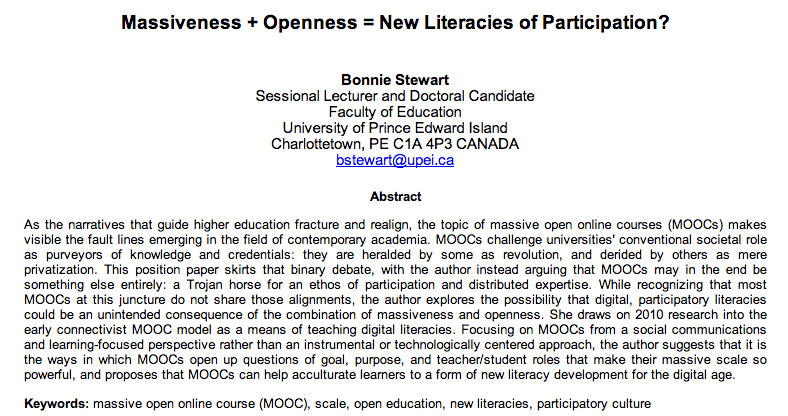
Train car #3 was, of course, a piece of writing. I published my first full-length peer-reviewed journal article last year, in JOLT. It’s ostensibly about MOOCs, but it’s far more a position paper exploring the possible decentering of top-down, teacher-centered concepts of education via massiveness, *if* – and it’s a big if – openness is fostered within MOOC structures (side note: HASTAC’s #Future Ed MOOC/movement launches this month and seems to be trying hard to actually do this).


Here’s the abstract, all official-like:

Screen shot 2014-01-07 at 11.24.23 PM

I wrote the paper almost a year ago now, but because I published it rather than blogging it, I’ve had little public conversation around the piece. It got tweeted a bit, and it’s been/being used in some cool open courses, which is wonderful and grand…but the kind of back and forth reflection that sometimes occurs here on the blog just never happened. And so when I was considering whether or not to use the article in the syllabus of my upcoming communications course and wondering, Bonnie seriously, isn’t that massiveness + openness stuff a bit idealized? I realized…I dunno. For years, my sense of my work has been that of a contribution to a conversation, a network. I didn’t notice how much I missed that. Until yesterday.

And then ye olde train cars of epiphany started to line up. CLICK.

I have spent the past year or so training myself painfully to try to write in all the forms my particular corners of the academy validate. I’ve done this rather blindly, as one aiming for desperate not-failure when one doesn’t have a clear enough picture of what success might be. And I have had success, in a sense – my proposal passed, my book contract was extended (sorry, JHU! MOOCs are…um…complicated), my paper’s been published. Other things are in the (slow) pipe. But in learning to write within the political economy of formal academic measures of success, I have lost something I valued.

I didn’t share most of what I wrote last year. It felt vulgar to shout “Looky here! Real live journal article!” so I didn’t blog about it. I stopped blogging about the book because the whole conversation about MOOCs got so fraught and so reductionist I didn’t really want to be in it, anymore. I didn’t share 90% of thesis proposal #2 until it was done, because the shame of struggling with academic writing seems a more terrible spectre than the shame of past-date Christmas trees. I don’t know how to talk about any of that stuff, or invite people into it. And so I’ve gotten lonely working away on my own because people are not in that stuff with me.

I’ve been researching hybrid scholars – people like me who are both cultivating some semblance of a traditional institutional academic identity and building connections and credibility for their ideas in online networks – but…and you may cue the laugh track here…I’ve been stumbling all over my own hybridity. I’ve been trying to be both networked scholar and proper academic, whatever that is. I’ve been trying to wear two entirely separate hats and engage in two entirely separate identity economies and…well, it’s a mug’s game.

And I don’t want to do it anymore. But. I’m not sure, frankly, which parts to drop.

That’s the hardest part about epiphanies, or at least the discount-version epiphanies I’m privy to…they’re never complete. A few trains line up and you pull ahead a bit and then some fall off or disintegrate or you crash into another and discover you need to change lines.

I want to make a career of scholarship in a time when the whole field of higher ed is practically in hiring freefall. I suspect, whether that ends up being my destination or no, I’l be – in the fine Myles Horton tradition – making the road by walking.

So I’m going to try to walk my way. I’m going to be hybrid.

If there’s anything to the premise that the potential of massiveness and openness = new literacies of participation, it’s those of us out here straddling the edges of old and new that will end up making and modelling those literacies, whatever they turn out to be worth.

And if you think that’s a ridiculous idea, I’d be ridiculously happy to engage in discussing it. Right here. Because neither an institution nor a journal can ever offer me the kind of space this blog does, for discussion of my work. They have their own spaces and values to offer, as do conferences and other conventions of legacy scholarship. I don’t think it’s either/or.

But if that’s true, we – I mean I – oughtta start acting like it, and stop re-enacting and internalizing artificial separations between spaces for knowledge production and learning.

After that, I’ll get that Christmas tree down.

Do you get stuck on the ‘shoulds’ of academic identity? How do you navigate fact that different and conflicting concepts of success and ‘good work’ are all currently in play? Do you think that’s always been the case, blogs or no?

the post-MOOC-hype landscape: what’s REALLY next?

My #mri13 keynote panel talk last week was on “the post-MOOC-hype landscape.” It was supposed to be about what I think we can do in the current “we have a lousy product” hype gulch before it all gears up again to bend the ear of NYT readers all over academia. And Silicon Valley.

The short version (see slide 4) is this: there are currently two solitudes in the MOOC conversation, and it’s not a cMOOC/xMOOC divide. One solitude – the mainstream media discourse – is essentially a unicorn, in the sense that its promises are fantasies of salvation and solutionism that have very little to do with the actual practice of higher education. The other – the practitioners’ discourse(s), broadly represented by the various interests around the table at #mri13 – is a Tower of Babel. Still, this solitude, loosely and cacophonously affiliated as it is, nonetheless leans towards discussing MOOCs in terms of learning. And in the wake of twenty-odd months of hype in which the dominant public narratives about higher ed have been all glorious revolution or ghastly spectre, I think it’s time to seize this (likely momentary) lull in unicorn sales and try to talk about MOOCs as learning. We need to make ourselves familiar with what the post-hype landscape of higher ed looks like, and address the issues and opportunities it’s left us with. In learning terms. On as many public platforms as we can. In stereo.

In other words, challenge the empty narratives that your administrators or your faculty have been sold. Find ways to talk about why what you’re doing matters. Change the narrative from unicorns back to what education is about: learning. End story.
***

Maybe I got it wrong, though.

In the revisionist history of my own mind, the “post-MOOC-hype landscape” is now forever linked to the unplowed freeways of the post-apocalyptic ice-storm-in-Texas landscape that stormstayed plenty of conference attendees in Arlington for the weekend. I got out, though dramatically. I pretty much hopped off the panel stage and into a taxi van with Dave, Mike Caulfield, Emily Schneider, two gregarious business dudes from Montreal, and a most intrepid driver, who happened to have grown up in India and had never seen snow in his life. The seven of us, strapped into our seatbelts over a set of summer tires that God never intended for ice, bumped steadily over a barren landscape of exit bridges and frozen plains speaking – at one point in the drive – in English, French, and Urdu all at once.

One of the Montreal business dudes managed to educate us all about bee death while also inquiring which language Dave & I make love in. (Apparently, folks, French comes highly recommended.) The other Montrealer, born on the subcontinent, sat in front and instructed the driver in their mother tongue on how to keep us the hell out of the ditch. A giant flashing billboard along the way proclaimed TRAVEL NOT RECOMMENDED. It reminded me of nothing so much as a scene from Mad Max.

But there we were, squished together.

It seems to me as good a metaphor as any for where we are with MOOCs and higher ed.

That second solitude – those of us whose research and practice focus on MOOCs right now – are like the seven of us in that little van. We’re a random collection. We don’t all know each other. We speak different languages and have different ideas about which ones are good for what. And we’re all of us inching forward in a space rendered unfamiliar by a freak storm – in one case ice, in the other, hype – that nobody’d expected in that particular context.

I got it wrong in the sense that the real ‘what’s next?’ may not be grappling with the unicorn narratives.

I think ‘what’s next?’ is working out the conversation IN the metaphorical van. Some who see MOOCs as learning focus on the pursuit of its ever-more-finely-honed measurement. Others are more inclined to dismiss measurement as irrelevant to the networked synthesis of ideas that forms the backbone of their approach to education. A hundred more do something in between. We don’t necessarily know how to talk to each other. It became evident around the Arlington bar tables last week that the chasms between practitioners’ varying versions of learning and knowledge are so deep some aren’t even really aware that the rest of us are IN the van.

That blindness – which we all, me included, probably suffer from to some extent – is dangerous. It’s dangerous because people keep trying to shove the future of education as a public enterprise into the van, without asking questions of what counts as education and of who benefits – and loses – if it becomes seen as a consumer commodity.

I don’t believe data has the sole answers to these questions. Conversations about theory and Big Data being post-theory kept emerging in Arlington, and have flowered further in the blog-to-blog flurry of discussion that’s circulated since we all escaped the Texas ice (Martin Weller & Mike Caulfield have written posts that make great bookends on the issues the End of Theory raises; Tanya Joosten & Jim Groom, among others, held court on the issue at the bar). But the elite university data scientists are notably absent from this networked conversation.

There are more solitudes here than my slide deck lets on. And like the unicorn narratives, Big Data tends towards being a totalizing vision.

Ontologically, the networked approach to MOOC learning and the AI-rooted machine learning approach are very different animals. They always have been, and the fact that we’re even all in this little van together bumbling through the post-hype landscape is as much a linguistic accident as anything: one NYT article and two very different conceptions of the Internet happening to education got hitched together on one wild ride.

I think there’s potential in that: there’s a lot about what analytics can tell us that interests me. But algorithms are not neutral, in my worldview. The Big Data researchers bring institutional clout and status to the conversation along with what struck me, in many cases, as an almost entirely un-self-conscious absolutism in their approach to knowledge and learning and the capacities of correlative data. And that raises issues about the future and direction of higher education and learning, far more than unicorn narratives ever did. When I say the MOOC narrative needs changing, I don’t mean it needs to become a monolith – it won’t. Part of its power is that many new stories of learning and education can nest themselves within it. Nor do I particularly expect to change the data scientists’ narrative on MOOCs and learning – except when they try to argue knowledge as truth over my prime rib dinner. But in the post-apocalyptic, supposedly post-hype landscape that was Texas, the biggest ‘what’s next?’ I actually came away with was the question of whether those of us most deeply invested in MOOCs at the moment can learn to live and work together in any real way.

As George Siemens said in the opening to the very first #mri13 session, these are issues of power. Educationally, ideologically…hopefully not apocalyptically.

Hang on tight, kids. The next van ride’s aimed for Charlottetown, for #mri14. It almost NEVER snows here in July, I promise. ;)

god bless us, every one

“I have endeavoured in this Ghostly little book, to raise the Ghost of an Idea, which shall not put my readers out of humour with themselves, with each other, with the season, or with me. May it haunt their houses pleasantly, and no one wish to lay it.”

Their faithful Friend and Servant, C.D.
December, 1843.
(from the Preface to A Christmas Carol, original edition)

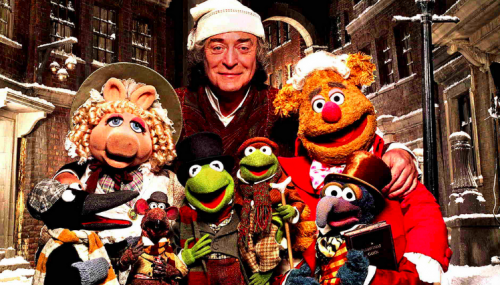
It’s all Dickens in our house, these days. I have a seven year old playing the part of Tiny Tim in the city’s production of A Christmas Carol: he’s rehearsing twenty or so hours a week and learning to sing notes no voice related to my own should ever decently attempt. Dave and I ferry him to and fro and discuss Victorian concepts of charity and debate the merits of his various fake English accents. We’ve also introduced his younger sister to the story via The Muppets so she doesn’t bolt in terror from our front-row-centre seats at the matinee when we take her to see him.

https://www.flickr.com/photos/ofsmallthings/8288450497

The movie-watching unfolded something like this:
five year old: Scrooge is bad!
me: Scrooge has made the mistake of thinking money is the only important thing in life.
five year old: Why does Scrooge want everybody to work on Christmas?
me: He can’t imagine anything else useful besides working, honey.
five year old: Scrooge leaves the little bunny in the cold!
me: Yes. At first he does, because he believes nobody else deserves anything of his.
five year old: Scrooge needs to learn to share!
me: Well, yes. And he does, right? He doesn’t want to live a life where nobody remembers or cares about him. So he opens his heart.

In the midst of this heartwarming tale of greed and redemption, a chill of doubt and fear struck me, and a cynical sub-narrative ran through my responses. Am I setting my children up for cruel disappointment by letting them believe in…Scrooge?
me (muttering): Power doesn’t seem to be as lonely these days as it was for the Victorians.
five year old: What?
me: Nothing.
five year old: Scrooge is sad because people say bad things about him when he’s not there.
me: Maybe the 1% should read what Twitter has to say about THEM.
five year old: What?
me: Nothing. Sorry. I was just thinking we still have some Scrooges in the world.
five year old: Why does Scrooge leave the poor bunny in the cold and throw things at him, Mommy?
me: Scrooge likes to believe that the people who don’t have what he has don’t deserve it. This is a mistake lots of people make, sweetheart. You should read the comments in The Chronicle of Higher Education sometime.
***

By mid-Victorian standards, the unredeemed Scrooge may have been a terrible, isolated cad. By the measure of the moment, his hearty embrace of a second chance at humanity seems to make him a less likely figure than Santa Claus.

Can I really raise my kids to expect that all it takes is a couple of ghosts to rid a heart of avarice and derision? Scrooge’s early outlook on the world was written as a scathing indictment of unchecked industrial-era capitalism, but he says little worse than can be found in any clot of online comments any given week…and not in the underbelly of Reddit, but in ye olde academic blogosphere.

Are there no prisons? the usual suspects snipe to the precariat who have not achieved tenure.
Are there no workhouses? they sneer at all who dared specialize in disciplines that aren’t, effectively, economic engines of their own.

When the ghosts of Christmas past arrive to point out that many struggling scholars chose their disciplines some time ago, as part of very different economic and cultural narratives? It doesn’t seem to register. Even when a Tiny Tim is held up, the first in his or her family to ever GO to college? Deaf ears. As one of these Tiny Tims who chose the field of education out of the best of intentions 20 years ago at 21, the year before the teaching market collapsed here and all the teachers stopped retiring, let me tell you: in a lot of families, just going to SCHOOL is a big, foreign, intimidating thing. When no one in your life can explain the difference between sociology and neuroscience and everyone you know just works at whatever job they can get, the concept of choosing a field based on return on investment isn’t even on the radar. Yet kids are just supposed to KNOW. Perhaps if the commenters spent their surplus hours consulting in local high schools rather than soapboxing on the internet, they could help save future generations of bright deserving youth. But let me tell you, even neuroscience ain’t a ticket to Easy Street these days, Mr. Scrooge, sir.

And when the ghosts of Christmas future intone that the tenture track is dwindling and in fact that higher ed would currently run aground in 20 minutes if all who teach within its hallowed halls were offered job security and a living wage? More selective hearing. The deserving will make it, runs the Victorian logic of parsimonious “charity” that only extends its warmth to those it recognizes as kith and kin, fellow winners in an increasingly stacked and unsustainable game.

(This is all to say nothing of the larger excesses and abuses of global post-industrial capital, of course, before anyone jumps in with that particular rhetorical parry. Western society’s most educated are hardly a sympathetic lot compared with those who mine the raw materials for our smart phones or who labour in condemned buildings to make the clothes we wear. Or those without the privilege of education in our own cities and towns. Fully agreed, full stop. That does not mean the increasingly disparate field of our own industry and agency is undeserving of regard.)

Secure or precarious, we are all tied like Scrooge to our desks these days, trying to fit more and more work and possibility into the same old 24 hours. If you have a reasonable job in academia after studying for half a lifetime? Please expect to work increasingly long hours on the treadmill for the privilege of believing you have not been left behind. If you don’t? Better bust your hump and distinguish yourself ever further, ever higher. And if the ghost of Christmas present dares show his jolly face and suggest you leave your toil for leisure?

The academy – and the rest of post-industrial capitalism – suggests you simply make leisure of your toil. We work on ourselves and our careers and our merged personal/professional identities, here in these convenient online spaces, around the clock.

We none of us have time for redemption, these days.
***
This all hits close to home because it is what I research. And I research it in the stuffed gaps between kids’ rehearsals and laundry and writing and presentations and sleep, like a proper 21st century Scrooge scholar. And then occasionally I have it reflected back to me from a perspective that turns it all on its head and I feel as if I am standing in a Victorian street in my nightshirt and bedcap, peering in at a scene and pleading, “No, spirit! No!”

A week ago last night I sent out notifications – invitations, thank yous, regretful ‘no’s to the generous people who came forward to volunteer for my upcoming dissertation research. I had a particular bounty of women from Australia, mostly white, mostly mid-career, and so one of the people I said yes to was almost a no until I plotted out my demographics differently and realized I had a gap that she might be able to speak to. I’d heard her voice for the first time ever just the week before, live from Australia in a fabulous late-night riff after my #wweopen13 live session ended. Kate.

She said yes, she’d be in my research. And then she dropped a little bombshell, gently, as you do when you are new to standing in the space where your audience’s jaw goes slack. She said “I’ve just been diagnosed with breast cancer. Just last week. The day after we talked.”

Well then.

Yesterday morning, I woke up to a post she’d published as what can really only be termed a wake-up call. She said, “You don’t have my consent to use my remaining time in this way. What do we do about the way in which overwork is the price that is now demanded for participating at all?” And then, “Hope is the alibi for inaction: what we need is the courage to put work itself at risk.”

Well then.

And I don’t know. Nor do you, likely. But a Christmas Carol played a major part in creating the public, political will to temper the excesses of industrial capital. I’d like to imagine Kate’s words could be the scathing indictment of post-industrial academia that we all need in order to reframe the pretend volunteerism that underpins so much of what keeps institutions going these days, without any real promise of reward or belonging in the mix. Perhaps we need this kind of story in order to be able to see the grotesqueries of our own culture, the spectres of our fear and our cultivated insecurity. Perhaps if we can see and own them, there is at least a chance of mitigating them.

But do not misunderstand. As Kate makes clear in the post, her diagnosis impels her and frees her to speak, but it does not make her different from any of the rest of us: “…it doesn’t make me differently mortal than anyone else.  We are neither vampires nor zombies, whatever the craze for playing with these ideas: we are humans, and we are all here together for a very short time, historically speaking. And so that being the case, the question facing us all is this: what do we do about work?”

That’s the thing. Kate is not Tiny Tim: we all are. And we are our own Scrooges, too, trapped in habits that will not magically change overnight, no matter the ghosts that visit. But the spectre of our own humanity and mortality needs to be one we all begin to pay attention to, and speak for. With courage, not just hope.