academic influence on Twitter: the findings

So. Since last November, I’ve been researching how networked scholars ‘read’ each others’ credibility and influence, when they encounter each other and each other’s work outside of the formal system of academia. I’ve been curious about the patterns running through the logics by which we make sense of each other; curious about what counts as influence in open networks. In a post a few months back I wrote:

“Influence is a complex, messy, slightly socially-discomfiting catch-all equation for how people determine the reputation and credibility and essentially the status of a scholar. There are two ways influence tends to get assessed, in scholarship: there’s the teensy little group of people who actually understand what your work really means…and then there’s everybody else, from different fields, who piece together the picture from external signals: what journals you publish in, what school you went to, your citation count, your h-index, your last grant. It’s credibility math, gatekeeping math. It’s founded in names and organizations people recognize and trust, with a running caveat of Your Mileage May Vary.

And now, in the mix, there’s Twitter. And blogs.

How can something that the general population is convinced is about what people had for lunch be a factor in changing what counts as academic influence?“

Well, here’s how. For real, with details and the permission of participants, the first run of findings from my ethnographic dissertation study of 13 actively networked scholars from various English-speaking parts of the globe. This is an excerpt from a larger paper currently under review…but this is the part I wanted open and out, now. “Findings” seems like such a funny word, suggesting this stuff was all laying out in the open to be stumbled over. In a sense, it is, always, every day, even on the days academic Twitter feels like crossfire. Yet it is also constructed, and situated, and ever-shifting. Feel free to post your caveats in the comments section.

WOOT. Onward.
***
WHAT COUNTS?

The central theme that ran through participant data was that scholars do employ complex logics of influence which guide their perceptions of open networked behaviours, and by which they assess peers and unknown entities within scholarly networked publics. More specifically, all scholars interviewed articulated concepts of network influence that departed significantly from the codified terms of peer review publication and academic hiring hierarchies on which conventional academic influence is judged.

While these concepts diverged, and I’ve attempted to be responsible to those divergences and diffraction patterns by sharing some breadth of the “history of interaction, interference, reinforcement, and difference” (Haraway, 1998, p. 273) within the space available here, they nonetheless suggest webs of significance specific to open networks. These webs of significance are, of course, situated knowledges, related to the stated and enacted purposes for which specific, variously-embodied participants engaged in open networks and the value they reported finding in them. Yet a number of patterns or logics emerged vividly from the data, in spite of the fact that participants had little in common in terms of geopolitical location or academic status positions. This suggests that alternative concepts of academic influence circulate and are reinforced by the operations of open, scholarly networked publics, particularly via Twitter.

It is important to note that participants’ stated reasons for engaging in open scholarly networks generally exceeded the instrumental “this will increase your dissemination and citation count” impact narrative. This may be in part because the study required that all participants had been active Twitter users for at least two years prior to the beginning of the study in November 2013: a review of higher education publications suggests the strategic narrative did not become prominent until after 2011. In any case, participant observation suggested that while some participants did primarily use Twitter in particular for broadcasting their own and others’ work, all participants in the study appeared to be engaged in curating and contributing resources to a broader “conversation” in their field or area of interest rather than merely promoting themselves or their work.

Among the 10 participants interviewed and the 12 who completed the profile assessments of other scholars (9 did both), there was consistent indication of an individual logic of purpose and value served by networked participation. In cases where participants reflected on their own changing practices over time, I observed a pattern indicating that an emergent sense of their own capacity to contribute to this broader conversation was part of the value participants attributed to networks. Particularly for those marginalized within increasingly rationalized institutions, and for those for whom the academic “role” does not cohere with a full sense of identity, reciprocal networked engagement can be a powerful way to extend beyond institutionally-sanctioned terms of circulation and value. In relation to the influence of others within open networks, participant responses suggested that they were able to perceive and ‘read’ influence outside their own areas of interest or the corners of the ‘conversation’ they perceived themselves contributing to, but were unlikely to follow people whom they perceived as disconnected from that particular part of the conversation, regardless of the apparent influence of those others.

Below are key emergent elements in these webs of significance, outlining what appears to count as a network version of academic influence in open scholarly networked publics. While both participants and exemplars gave permission for me to identify them by Twitter handle in all research publications resulting from the study, I have anonymized specific quotes from participants in relation to exemplars and identifiable others.

“She sure has a following” – Metrics matter, but not that much
A primary finding of the research was that metrics –the visible numbers attached to social media profiles and blogs – are seldom taken up in isolation. Participants showed a nuanced and relatively consistent understanding of metrics: the higher the number of tweets, the longer a profile was assumed to have been active, and the higher the ratio of followers to following (Twitter does not require reciprocal ‘friending’ in the way Facebook does), the more likely the person was to be perceived as influential. Yet equally consistent across the data were caveats of context, in which participants made clear they seldom interpret the metrics of public Twitter profiles as a final indicator of a scholar’s influence or potential value to their own network.

@socworkpodcast: “Status does play into my decisions to follow someone, if I see someone with a huge following, whose bio suggests this is a thought leader or a person of influence online/offline. I will look through the feed to see if the most recent 100+ tweets seem like things I could benefit from professionally, or that my followers might value.”

@antoesp: “I find it intriguing to discover how we all are able to provide a defined aspect of our multiple self through the micro-portrait in the personal twitter account. Usually I don’t choose to follow someone only on the basis of this micro-portrait, but I follow the link to his/her blog/SN profile (if provided).”

Most participants reported scrolling through tweetstreams and looking at blog links before making decisions about following: a few noted that profiles without links to external sites “for ideas in more than 140 characters” are profiles they generally avoid following.

The exemplar profiles with the largest number of followers and ratios indicating a high scale of attention did tend to be assessed as more influential. High tweet numbers indicate longevity on Twitter and appeared to factor into many participants’ assessments of others: some noted they were more likely to invest in following an established profile with many tweets because they could assume ongoing contribution rather than an account that might go dormant. This was particularly true among participants who appear to maintain a cap on the numbers of users they follow: this may indicate impression management regarding their own follower/following ratios, as well as efforts at signal/noise control. However, low tweet counts or relatively even follower/following ratios did not necessarily result in dismissal of influence: it was noted by participants that accounts with smaller followings can simply reflect relative newness within the Twittersphere. One participant noted, of small accounts, “Might just mean they haven’t done anything ‘viral’ yet. But I’m more concerned with content and interests.” Profiles that had not been adapted or personalized at all, though, were commonly interpreted as signaling a lack of value.

@miken_bu: “I check their twitter profile, read some recent tweets and perhaps check out their blog or web site… I do try to follow folks who have differing views or from differing backgrounds to reduce the echo chamber. I rarely follow anyone who has an egg image and no profile info, though, unless I know them already.”

@katemfd: “Sometimes…I’ll choose someone with twenty followers, because I come across something they’ve managed to say in 140 characters and I think… “oh, look at you crafting on a grain of rice.”

In terms of how participants amplify other voices in their own Twitter timelines, however, metrics appear to count to some extent. During participant observation, the majority of participants were more likely to re-tweet (RT) users whose scale of followers was higher than their own. Even where participants clearly made themselves available to engaging in discussions with users of all stripes and sizes, the tendency to amplify larger voices was consistent among all but the largest accounts in the study.

“A rolling stone gathering moss”- Identity at scale
While size or scale of account was not taken up as a direct indicator of influence or value, there did appear to be a critical mass at which those who are visible in open networks to become ever more visible. A number of interviews – with participants of varying scale – noted that for large accounts identity and reputation can become “a thing,” and the reciprocal communications upon which many participants build their networks becomes difficult to sustain.

@catherinecronin: “Large nodes in a social network have more visibility, their network activity gets amplified, and they become larger yet. In Twitter this happens in many ways – through RTs, through publication of “top educators to follow” lists, etc.”

@wishcrys: “I think when someone is a Twitter personality with a Twitter reputation, regardless of their content people are just going to like it – reputation comes to overshadow content. At that point you’re no longer a content producer, you’re probably just a Twitter personality…everything you say is Gospel Truth. Whereas when you’re lower down and trying to gain some form of connection, recognition, some sort of following, your archive and content are what leaves a mark.”

Participants who had reached significant scale with their own Twitter accounts, blogs, and digital identities tended not to speak about size of account as a benefit or goal, but more as an identity shift; one that involves challenges, adjustments, and responsibilities, as well as privileges.

@raulpacheco: “(January 2014) –I find when I have conversations on academic Twitter my brain starts absorbing information on data and learning, new ways of looking at things. I’m addicted to my mentions tab – I love hearing people react to what I say.” (July 2014: Skype chat) – “I’ve reached peak tweetage. I can’t answer every single @ reply as I used to (related to how much my follower count has grown).”

@readywriting: “I make sure that I amplify a lot of adjunct voices now. I think that’s really important. POC, other marginalized people…I recognize my privilege and want to use it for some good, even if it is just amplification.”

“Status baubles” – The intersection of network influence with academic prestige
The intersection of high network status with lower or unclear institutional academic status was a recurring topic in interviews, in reflections, and in public Twitter conversations. Participants indicated that the opportunities sometimes afforded junior scholars with network influence can create confusion and even discord within the highly-codified prestige arena of academia, because the hallmarks of network influence can’t be ‘read’ on institutional terms. Networked scholars were acutely aware both of network and academic terms of influence and appeared to codeswitch between the two even on Twitter and in other network environments. However, they noted that colleagues and supervisors tended to treat networked engagement as illegitimate and, in some cases, a signal of “not knowing your place.” Of the alternate prestige economies that intersect with academia, participants reported media exposure as the most coherent to their less-networked academic peers.

@tressiemcphd: “It’s the New York Times and the Chronicle of Higher Ed…I get emails from my Dean when that happens, when I show up there. With the Times I get more from the broader discipline, like a sociologist from a small public school in Minnesota – people not so much in the mix prestige-wise, but they see someone thinking like them, they reach out. But the Chronicle gets me the institutional stuff: I’ve got a talk coming up at Duke, and the person who invited me mentioned that Chronicle article three times. It’s a form of legitimacy. It shows up in their office and so they think it’s important.”

@thesiswhisperer: “I’ve grown this global network sitting on my ass and it offends people. And I’m really interested in that, in what’s going on psychologically with that, they say “it’s not scholarly” but it’s really just not on their terms. It has success. But when you’re the one getting keynotes people who’ve bought into older notions of success, they feel cheated.”

“I value their work, so value by association” – Commonality as credibility and value
When it came to indicating whether they would personally follow a given account, participants appeared to give less weight to metrics and perceived influence than to shared interests and perceived shared purpose.Most participants appeared to be actively attempting to avoid what Pariser (2011) calls a ‘filter bubble’ in their networks. Rather, many reported seeing themselves as responsible to their own networks for some level of consistent and credible contribution, and so sought to follow people who would enrich their participation via relevant resources or common discussion topics.

Where commonality appeared even more important to participants, however, was in peers or shared networks: when a logged-in Twitter user clicks on another user’s profile, the number and names of followers they have in common is visible. This visibility serves to deploy shared networks as a signal of credibility in an environment where identity claims are seldom verifiable. Many participants spoke to the importance of shared peers over metrics or other influence factors in terms of whether they choose to follow. In assessing a full professor with more than 1,300 followers, one participant noted that the metrics did not sway him: “Looking at the number of followers and tweets, it would seem as if this person has some ‘gravitas’ in the field.  Just judging from his profile – I would not be particularly drawn to following him because his field is chemistry. I searched his profile online, and looked at his tweets, and he tweets mostly about non-academic issues e.g., coffee, football, etc.” Whereas the same participant then indicated he would follow another profile with only 314 followers, due to shared networks: “she is followed by a number of people whom I respect and follow. So I will give her a try.”

Participants tended to look for common interests on top of common peer networks, however. One mentioned, “I often follow people who others I follow also value – after ‘checking them out’ via looking at some tweets, profile, etc.” Another echoed, “I see that we share 65+ followers, so there are obviously many connections. (Her) interests match mine somewhat, she shares resources as well as engaging with many people…I also see that…(her) use of these particular hashtags tells me that (her) interests are closely linked with mine.”

Commonality was also overtly valued where participants used networks as ways of connecting with other scholars for support, encouragement, and specialized information: this was common both among PhD students and early career scholars in the study, as well as among those who use open networks for ongoing learning. One PhD candidate reflected on the value of another PhD student account, “As a PhD student, she is a colleague studying topics close to my interest. I am likely to follow her for a sort of…solidarity among peers, beyond the actual contribution she could bring.”

“Being connected with Oxford adds to the reputation” – Recognizability as a way of making sense of signals
The value placed on shared peers reflects a broader pattern observed within the research: recognizable signals have a powerful impact on perceived influence and perceived credibility. In the same way that recognizable journal titles or schools or supervisors serve as signals of conventional academic influence, so do both conventional and network factors of recognizability carry weight in assessments of network influence. Thus, shared peer networks matter, as do visible acknowledgements such as mentions and retweets; additionally, familiar academic prestige structures such as rank and institution can add to impressions even of network influence.

One of the most vivid examples of this was the workplace listed on one exemplar’s profile: Oxford University. The vast majority of participants who were shown this exemplar noted the Oxford name, and there was an overwhelming tendency to rate the account as influential. However, as previously noted, influence did not carry as much weight as commonality when participants were asked to weigh whether they’d follow a user: one participant reflected, “Is based at the University of Oxford – signaling for me a possible gravitas/expertise in the field. Looking at his tweets, he does not tweet a lot about academic issues – so he is most probably not, in my opinion, a very ‘useful’ person in my network.”

The Oxford exemplar also raised the issue of reciprocality and the ways in which its likelihood is minimized by scale of metrics and by prestige. One participant was frank: “This person seems like a very successful academic and is doing forward-thinking work at one of the oldest and most prestigious institutions in the world…(but) I have not followed him and couldn’t imagine he’d follow me.” Another was more overt about the ways in which influence is generally understood to affect engagement: “Clearly a more discerning twitter denizen (note the number of people following him vs who he follows), which would tell me he might not be big on interaction.” Thus, imbalance of scale does not necessarily fit with the purposes of connection and tie-building that many scholars turn to their networks for.

Outside the Oxford example, institutional affiliations or lack thereof did not have much effect on participants’ responses to exemplars, presumably because few institutions in the world carry the recognizability and prestige that Oxford does. Still, institutional affiliations can operate as credibility signals even where prestige structures are not involved.

@exhaust_fumes: “I care a bit about institutional affiliation in profiles…less that the actual university matters or rank matters, but that people are willing to put any institutional info up makes me more inclined to follow because I find relative safety in people who are clearly on Twitter as themselves as academic-y types and therefore aren’t likely to be jerks without outing themselves as jerks who work in specific places.”

Willingness to openly signal one’s workplace can operate not only as a verifiability factor but as a promise of good behavior of sorts. However, signals of institutional academic influence were also read as indicators of identity and priority: in reference to a profile that opened with the word “Professor,” one participant commented, “When a profile leads with institutional affiliation, I assume that is his primary role on social media. The rest of the cutesy stuff is there to humanize but he is signaling who and what he is in the traditional power structure.” Scholars who emphasize their conventional academic influence signals may limit the level of network – or “born digital” influence they are perceived to wield.

“A human who is a really boring bot” – Automated signals indicate low influence, especially in the absence of other signals
One clear indicator of a lack of network influence was automated engagement. Three exemplar identities had automated paper.li or Storify notifications in the screen-captured timelines that were shared with participants; one exemplar’s visible tweets were all paper.li links, or automated daily collections of links. Responses to the paper.li were universally negative, even where the exemplar was otherwise deemed of interest. “Potential value to my network – she tweets relevant stuff so probably I should follow her! On second thought, she has a Paper.li, and by definition I unfollow anyone who uses that tool.” Other participants were equally direct: “The only negative for me was the link to a daily paper.li. I tend to find those annoying (almost never click them!)”

Storify was not interpreted to indicate the same level of low influence or awareness, but its automated tag feature was still a flag that participants mentioned: “This is on the fence for me since Storify takes some effort to be engaged with things and maybe she didn’t get that she can opt out of those tweets informing people that they’ve been “quoted.”

“My digital networks provide me with some sense of being someone who can contribute” – Identity positions and power relations
Participants’ nuanced sense of influence in networks was particularly visible when aspects of marginality and power were explored. While none perpetuated the narrative of open participation as truly or fully democratic, many did note that networks have created opportunities and access to influence in different ways than their embodied or academic lives otherwise have afforded.

@raulpacheco: “In a very bizarre way, having a well-established academic and online reputation makes me feel pretty powerful, despite being queer and Latino…both elements which should make me feel handicapped. My thoughts are well received, generally, and my stuff gets retweeted frequently.”

@katefmfd: “Networking online has enabled me to create a sustaining sense of my identity as a person, in which my employment in a university plays a part, but isn’t the defining thing…my networked practice is much more closely aligned to my personal values, and much more completely achieved.”

@14prinsp: “My identity intersects with a particular (South African) view of masculinity and patriarchy – there’s vulnerability here. I’m out as a scholar, and I’m also HIV positive and am out in my department…I was very sensitive when I started blogging that if I said something stupid it would be there til death do us part, but I’m very aware that I manage my identity, I make very critical choices. It’s reputation management, it’s brand management, not in a superficial way: there is definitely some authenticity in it but it is carefully chosen.”

Particularly among PhD students and early career scholars, the norms of open online participation helped minimize academia’s hierarchies for participants.

@andreazellner: “I feel like Twitter is the Great Equalizer. Take a recent back and forth with the Dean my college…I am too intimidated to talk to him and he has no idea who I am, and yet on Twitter he posted about being at Microsoft Research and I started asking him questions. He ended up tweeting pictures of things I was asking about, etc., and we even traded a few jokes.”

@tressiemcphd: “My position in the prestige structure didn’t always match my ambitions and what I felt I could do, felt compelled to do. (Networks) allowed me to exist without permission: I was never going to get institutional permission, there was no space there.”

@wishcrys: “I’m far more likely to tweet to my academic superheroes or superiors: I’m not very likely to walk up to them and go “hey, great book!” I definitely feel much more comfortable doing this on social media…people aren’t going to remember my research five years down the road but they may remember that nice PhD student who sent out a nice tweet at 3am.”

Finally, it was noted that the relational connections created in open networks nonetheless reproduce many of the power relations of institutions and society, even while challenging some of their hierarchies. Networks were reflected as an alternate status or influence structure that intersects with academia, rather than as truly open fields of democratic interaction.

@readywriting: “I’ve consciously worked to follow people outside the class/race/gender norm: one of the evaluative things I do when I encounter a new person on Twitter is ask myself  “is this person a little outside of the norm? Great. I want to learn from him/her.”

@catherinecronin: “Twitter is ‘flatter’ than some other networks/media, but power relations exist on Twitter — there is no doubt about that. The online very often reproduces and amplifies what occurs offline. However, open online platforms can also subvert the usual power dynamics. Those without access to conventional public communication channels can use social media to build networks and influence outside of institutional and cultural power structures.”

***
So that’s a start. There’s so much more data that I’m beginning to realize I’ll never do it all justice, the rich conversations, the mountains of Twitter favourites, the backchannels, all these signals that constitute a body of research just as they constitute the water many of us swim in, as networked scholars. My next paper will take this on from a literacies perspective, rather than strictly from an influence perspective. I keep learning.
The Old School – Sexism, Social Media, Campus Culture, and Identities

Mostly, when I write and talk about social media, the riskiest thing I’m doing is destabilizing a few people’s dearly-held concepts about the ways in which scholarly influence operates and circulates within academia.

This past weekend, though, I had the privilege of doing something that felt much more dangerous – I talked about the culture of sexism and sexualized violence on campuses and in society at large. In a keynote, on a campus where last year’s student orientation chant about non-consensual sex hit Youtube and made national and international news. The audience, mostly from Maritime Canada higher ed institutions, were lovely. Designing the talk was terrifying.

Not because I was talking particularly outside my field: I wasn’t. I talked about it all through the lens of social media, as both a symptom of and contributor to the problem. I talked about #yesallwomen and about the UCSB shooting and Men’s Rights Activism sites and about how social media amplifies all aspects of who we are and what we think and believe, and reflects society’s power relations as much as it also actively tries to shape them. I talked about how the stories we tell ourselves about technologies are often deterministic, even scapegoating, focusing blame on gadgets rather than on ourselves. It was a culture talk, a structure talk, and a history talk, in addition to being a social media talk. I was proud of it.

And it went well, though I can’t entirely credit my carefully-crafted navigation of the semiotic landscape of gender and power. It worked in part because I didn’t actually have to introduce the topics of conversation or carry them into the arena for discussion: I followed on the heels of the very sincere and very illustrious Wayne MacKay, whose bio features his Order of Canada and the fact that he chairs committees and councils on cyberbullying and sexualized violence on campuses and is a lawyer and professor and former President of my undergraduate institution.

(My bio, on the other hand, pretty much mentions that I have a Twitter account. To thine own self be true.)

It wasn’t punching above my weight that felt dangerous. It was the in-between space of the topic: the fact that what is sayable about the reality of gendered identities and sexual politics these days is fraught and limited. The fact that – and this is at the core of everything I tried to say – they have ALWAYS been fraught and limited. The fact that as a 42 year old grown woman with a big-ass vocabulary, using the word “patriarchy” in a public conversation – online or in person – still makes me nervous. Because I don’t much enjoy being diminished and abused, full stop, and while correlation may not be causation, I tend not to stick my hand back on the stovetop after a burn.

When high-status white males lend their voices to framing these conversations, it’s easier. Their very presence does the discursive work of legitimating the topic, making it a Very Important Thing and not an attack from the margins. In the case of Saturday’s conversation, it also helped that we were addressing college and university student services professionals who live and walk the talk of diverse, inclusive campuses far more adeptly and viscerally and vigilantly than many in higher ed. But Wayne and the gentleman who opened the day also introduced terms like misogyny and rape culture to the conversation, leaving me free to deepen that conversation rather than spend my hour trying to justify having it in the first place. Their acknowledgement of sexism and sexual violence as problems within campus cultures was key.

But the very identity positions that enable white Boomer males who sit at tables of power to speak of sexism and sexual violence without being seen as accusing also allow them to reify frameworks that neutralize and distance these phenomena, whether they mean to or not. Talk of hookup culture and social media and values serves to make this a “kids these days” conversation, not a conversation about the imbalance of power and identities in our culture. It makes the problem new. It makes us – the grownups – less complicit.

Let me be very precise. This is not new…it is old school, in the most literal sense. We are simply forced – by virtue of an immersive and intrusive news culture and the rise of risk management and institutional optics – to talk about it.

I talked about this in terms of stories. Stories are the ways in which we understand who we are, and our stories of culture and technologies right now are failing to give us any tools we need to develop productive identities for the world we’re in.

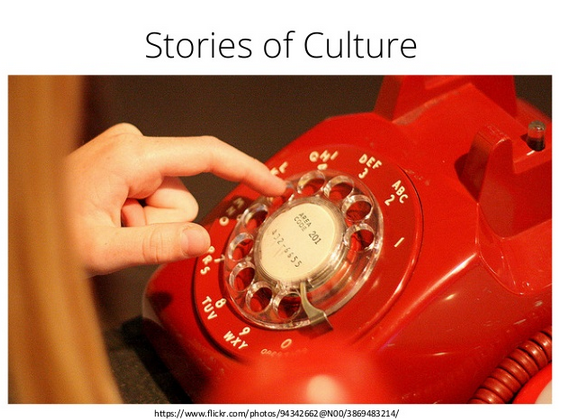
I told a story about obscene phone calls. When I was nine or ten, my mother and I had a caller who harassed us for months before the threat of being traced finally got rid of him. Screen Shot 2014-06-09 at 9.32.07 PMEarly on, before my mother banned me from answering, I heard the deep, heavy breathing on the other end of the line. I suspect he said more to my mother, because I remember the sharp staccato of her voice, fearful and indignant. I knew from my friends that if we’d only had a man in the house he could’ve gotten on the line and scared the caller into going away. I decided that when I got old enough to get my own phone line I’d put it in my initials, not my name…because I was female. I also began cultivating the deepest, most rumbling voice I could. I wanted to be heard.

Of course, by the time I got old enough to have a phone line of my own, call display had largely wrecked the obscene phone call market and its capacity to assert power and create fear without actually facing personal consequences. The heavy breathers had to go underground and wait for the Internet, for underbelly pockets where they could congregate, no longer isolated, and reflect and amplify each others’ fledgling desires to exert power without consequence, to create fear in vulnerable others. The desires are not new. The technologies of our time regulate and constrain the identities we get to try on for size.

Screen Shot 2014-06-09 at 10.13.55 PM

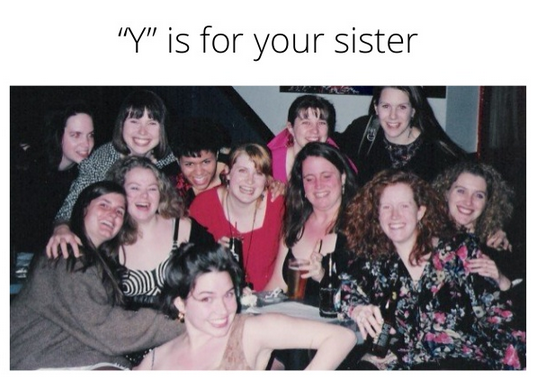
Mount Allison women’s rugby, 1993

So do our cultural artefacts, and our frames of reference. I  told a story about the chant that scandalized Canadian higher ed last fall. I said that while I shared Wayne’s dismay at the fact that it was part of orientation in 2013, I didn’t share his shock: I knew the words. Twenty years ago, at the university where Wayne was later President, I learned that chant at a rugby game.

The student leaders interviewed last fall about the chant said they’d never really listened to the lyrics. I had. I’d heard and understood, just as I understood the rest of the songs that made up the raucous rugby identity: I just didn’t know what the hell to do with any of it, because I did not know if I could object and still belong. The rugby club was the first mixed-gender space I’d found where I did not feel diminished by the fact that I did not interact like a *lady.* Rugby didn’t take itself too seriously, and I thought I had to not take myself too seriously, either. So I sang along and I drank along and I tried to straddle the cognitive dissonance of it all, and mostly I failed and felt prudish and then tried harder. I did not even know it was supposed to be different. I did not know how to get outside it. It was called a tradition and it appeared to be the water we swam in and so I joined in and perpetuated it because I wanted that sense of belonging and I had no role models for a different discourse. And that is not new, either…but in the smallest ways it is shifting. Because peer-to-peer media don’t just de-isolate the heavy breathers, but those on the other end of the line. They allow outpourings like #yesallwomen as much as they allow forums for MRAs and PUAs. They allow those of us who work on campuses to connect and engage and try to set different frames of reference for campus identities, different examples, different discourses for belonging. They will not magically solve anything. But used well, they can be the kind of signal that enables people – male, female, whomever – to begin to be able to think about objecting, and changing traditions, without having to give up hope of belonging.

Or so I said Saturday. In the end, that talk didn’t feel nearly so risky in the delivery as I’d feared and I was heartened and for a minute I even thought, “maybe it’s not so hard to have this conversation after all.”

Then George Will popped up in The Washington Post yesterday. And I laughed at my naivete and realized this conversation has barely begun.
***

You’ve probably seen the article by now, deriding “the supposed campus epidemic of rape: aka “sexual assault.” Note the scare quotes. That’s the tone of the whole piece: “micro-aggressions” and “survivors” get the same contempt. The article conflates the recent trigger warning kerfuffle with an overall moral panic about how progressivism has made everyone on campuses “hypersensitive, even delusional, about victimizations.” Will asserts that victimhood is a coveted status on American campuses, one that now confers privileges.

I won’t bother to explain that it is not a privilege but a human right to assert that one is not just a sexual object, even when one is treated that way. I won’t bother to explain that when one DOES assert this right one is often treated to the very questionable privilege of being publicly excoriated and shamed by people like Will himself.

(I will bother to explain – to all of us, even the most active in peer-to-peer communications – that when the surge of people talking about structural grievances like racism and sexism and rape threats and able-ism and the right to speak from identity positions we do not happen to fully understand, share, or agree with begins to sound like victimhood as privilege, we might want to hold that judgement. Because yes, identity and power politics are messy and conflated right now. Yes, it can make some of us with actual structural privileges in the matrix of societal domination feel unfamiliarly – even unfairly – silenced in arenas we are unaccustomed to, and yes, some people will navigate these new discursive regimes in ways that are sensationalist or distasteful or whatever. This is the price of a performative public sphere. Nobody gets to be neutral).

But the privileges of victimhood are not the conversation Will is actually in. He’s in the conversation about who has the right to do what to who; the conversation about what we uphold as unwritten codes of whose bodies and actions and decisions count. This is smack in the middle of Todd Akin “legitimate rape” territory. This is about the privilege to exert power without consequence, to maintain stability in the categories of who counts as a vulnerable Other. This is an old conversation, but one we didn’t have to have publicly for a long ol’ time because respectability politics is powerful, silencing stuff and belonging has long been the price of speaking back.

So I’d like to thank George Will for prompting me to take my keynote from Saturday public. Again, let me be very precise. This issue is not new, and the only privilege here is the privilege that Will is daring us to wrest from him, in Charlton Heston “from my cold, dead hands” style. He may dismiss the #survivorprivilege hashtag that arose in response to him. But he cannot silence it. And as someone who has worked on higher ed campuses for the past fifteen years, I see that as a positive beginning.

what counts as academic influence online?

Sometimes things shift when you’re not looking.

I woke up last Monday morning to discover that practically every Chronicle link on my Twitter feed related to my research area. Not in any elbowing-in-on-territory kind of way, but rather in a “whoa…serious synergy here” fashion.

Sometimes, when I get up in front of fellow educators and academics and say I study scholarship and…Twitter, I end up feeling like I’m doing stand-up comedy. Really? Twitter? say people’s eyebrows. I am becoming a great student of arched eyebrows.

Yet on Monday, casual academic readers of The Chronicle – and their eyebrows – would’ve been hard-pressed not to come away with the impression that academic identities in social media are actually Something To Care About, as a profession.

(Naturally, this will have backlash. People’s eyebrows generally do not LIKE to be beaten about the head with the idea they should care about something just because suddenly it’s the Flavour of the Month. Nor should they. I feel you, eyebrows of the world).

Still, the sense of critical mass is energizing to me. The work of research that is not legible to others always feels, rhetorically, like lifting stones uphill: constantly establishing premises rather than moving on to the deep exploration of that one particular thing.

The more the conversation about networks and identities and academia grows and pervades people’s consciousness, the less of that Sisyphean phase of the lifting I need to do.

Because this is not a Flavour of the Month, folks. This is a cultural shift, one part of the sea change in contemporary higher ed.

Dear arched eyebrows: this doesn’t mean you have to use Twitter. Or any other social networking platforms. Nor do you need to get personal online if you don’t wanna. But your concepts of academic identity and academic reputation do need to expand. Twitter and social media are now a part of scholarship, as modes of communication and of scholarly practice. So if I tell you I’m exploring the part they now play in academic influence…try not to arch so hard you hurt yourself.
***

I had the privilege of giving a keynote at the University of Edinburgh’s E-Learning conference two weeks ago now, hot on the heels of the very good time my mother and I had at #nlc14 there this year. If you missed us, we were the really excited Canadians swooning at all the Scots accents. ;)

The theme of Edinburgh’s E-learning conference this year was authenticity…a word that makes me a little wary. Authenticity matters. But authenticity can also be a weapon wielded to defend the “real” (read: the non-digital, or the traditional, or the tidily, smarmily Hallmark-branded) against whatever binary or straw man it chooses.

So I talked about networked scholarship, exploring the question of what counts as authentic academic influence now.

Basically, it coulda been subtitled “How Do Scholars Use Networks And What Does That MEAN?” or…”WTF Is A Graduate Student From Another Country Doing Giving A Keynote, And How Did This Happen?”

In the talk, I outlined some of the preliminary findings from my research these past few months, including what scholars seem to use networks for and what kinds of patterns emerged from the tweets and RTs that flew through my timeline this past winter. The slideshow above gives a taste of some of the tweets I flagged during the last few months of research (note: not all are from my participants). But what I really talked about was influence.

The Math of Influence
Influence is a complex, messy, slightly socially-discomfiting catch-all equation for how people determine the reputation and credibility and essentially the status of a scholar. There are two ways influence tends to get assessed, in scholarship: there’s the teensy little group of people who actually understand what your work really means…and then there’s everybody else, from different fields, who piece together the picture from external signals: what journals you publish in, what school you went to, your citation count, your h-index, your last grant. It’s credibility math, gatekeeping math. It’s founded in names and organizations people recognize and trust, with a running caveat of Your Mileage May Vary.

And now, in the mix, there’s Twitter. And blogs.

How can something that the general population is convinced is about what people had for lunch be a factor in changing what counts as academic influence?

Here’s how.

Beyond Gatekeeping: Networked Influence Signals
Going online and talking to people you don’t know about areas of shared scholarly interest opens up your reach and reputation for what you do. It opens up your capacity to build communities of practice around shared interests. It opens up the possibility that when people in your field – the people reviewing your panel or on your next granting committee – hear your name, it will be one of those they already recognize and trust. Maybe. There’s a LOT of Your Mileage May Vary here.

Think of a Venn diagram – here’s how scholars traditionally share their work, here’s what people had for lunch – and in the middle there are scholarly ideas ON social media. What I’m trying to do in my research is to identify the implicit literacies involved in making sense of identities and reputations and credibility in this intersection. Because so long as senior scholars and administrators and tenure committees think Twitter is what people had for lunch, there’s a gap in our understanding of influence signals, especially in fields that are changing rapidly.

I’m finding patterns and commonalities in how scholars use Twitter, and the things they express there. In the slideshow above, you’ll see that the touted “it increases your dissemination!” factor is important in shaping scholars’ practices, but for many that’s reported more as a side effect than a reason in itself. Community and connection and space to address marginalities on many fronts factor more powerfully in participants’ accounts of their networked practices, particularly for those who use Twitter for more than broadcast purposes.

At the same time, networked participation and networked connections and their non-institutional logics also bring more fraught elements overtly into play in the influence equation.

Enter Capitalism
Now, let’s not pretend that academic institutions are not capitalist institutions. They are, and increasingly so: capital equations of scarcity and commodity are very much a part of the institutionalized and gatekept versions of academic influence signals that have gained traction over recent generations. But the individual scholar in these equations is, except in superstar instances, an institutional role rather than an identity unto him or herself. In networks, individual identity operates as a brand, particularly as the scale of attention on an individual grows.

This allows junior scholars and adjuncts and grad students and otherwise institutionally-marginalized identities to build voices and audiences even without institutional status or sanction. It allows people to join the conversation about what’s happening in their field or in higher ed in general; to make contributions for which channels do not exist at the local level. Networked platforms act as hosts for public resistance to the irreconcilable contradictions of contemporary academia, as well as society more broadly. But networked platforms are still corporate platforms, and should not be seen as neutral identity playgrounds. As Tressie MacMillan Cottom and Robert Reece ask in this sharp piece on hashtags and media visibility, “how radical can your resistance be when it both funds a corporation and is subject to the decisions of that same corporation?”

Power in Networks
Being visible in networks *can* create access to visibility and voice in broadcast media, which sometimes lends perceived credibility to the way a scholar’s work is taken up…or at least amplifies his or her name recognition. The power relations of scale are complex, though: the racism and sexism and heterosexism and able-ism and Anglo-centrism of our contemporary world are in many ways replicated in the ways voices get heard, online, and the backlash for women and people of colour who dare to speak can be vicious. The constant identity positioning and lack of transparency and understanding about how visibility works can also make the world of academic Twitter into mean streets, sometimes.

The biggest factor in building influence in networks – one that should assuage some of the arched eyebrows – is that it tends to take, like all scholarship, a great deal of time and work. Twitter is not a magical path to fame, or to celebrity academic status. In fact, on its own, it’s created few superstars: the traditional, institutional halls of power and high status still do far more to thrust scholars into influential circles of attention and public regard. Noam Chomsky’s speaking fees are not especially under threat from Twitter upstarts, and Twitter and blogging alone do not often result in New York Times gigs. But they are, now, indubitably a part of that picture, in ever-expanding circles.

I see the networked version of academic influence as what Audrey Watters calls “a cyborg tactic:” the illegitimate offspring of complex totalizing equations, and yet potentially subversive to them. This potential lies, as Haraway would put it, in the fact that illegitimate offspring are often “exceedingly unfaithful to their origins.” As a development in how scholars understand each others’ signals of credibility and reputation, networked influence is neither good nor bad, and certainly not neutral. But it is, and it is important to try to understand.

And to those who would raise their eyebrows at this assertion, I say: sometimes, folks, things shift when you’re not looking.

Notes to Self: A Networked Ethnography of…Networks. Stage One.

This is the first post in a series outlining my ethnographic study of identity positions in online scholarly networked publics.

It is a way of beginning to write out my research in a context with fewer formal constraints than publishable academic writing will demand. It is also a way of communicating with participants and with my own networks about how I’m beginning to make sense of the work I’m doing. It’s a space wherein people can comment/add/speak back to the ideas I’m exploring, before I trap them in the amber of print format.

Lastly, it’s a trail of breadcrumbs: I’d like to be able to look back from wherever this research eventually leads me and trace some of the process of getting there. It’s here for the nibbling:no guarantees about where it will lead, but anyone else thinking about ethnography in the open is free and welcome to make use of it too.
***

Step One: Find Volunteers
In November of 2013, I put out a call for research participants via my blog and Twitter. Scholars, I said, are you on Twitter? Can I come live like a fly on the wall of your networked publics for awhile and look at how influence, credibility, and identity positions work in your online worlds?

They said yes. Bless them, they said yes.

I’d wanted twelve participants, maximum – ethnography is about depth, not about quantity – but I was floored by the volume and generosity of responses I got. Nearly thirty volunteers responded to the open call, and I tapped a few more by following up on previous expressions of interest in the project.

Step Two: Select Participants
Then, the great cull. Of all the things I’ve done with this project in the last three months, this was by far the most challenging. It wasn’t technically hard – I had a pretty tight set of requirements that I’d laid out in advance and made public in the call – but the act of choosing and owning my choices involved internalizing methodology and enacting its particular rigour upon myself.

The long, circuitous research and writing phases of my thesis proposal, intense and personal though they’d been, had involved some separation of self from work. The intensely reflexive process of challenging, adapting, and coming to own the analytic framework I’d developed in the proposal dissolved that comfortable distance. The process of selecting participants from a rich pool of volunteers – many of whom I knew, respected, and wanted very much to build or maintain positive network ties with – was the point at which I came face to face with the power and risk inherent in the identity position of “researcher.” It is one thing to understand that research “worlds” particular constructions of human value and knowledge into being, and another to actively prepare to stand openly and nakedly alongside those constructions and the selection process they represent, ever in conversation with their premises and conclusions.

My methodological approach is rooted in Patti Lather’s (1986) critical ethnography work on reconceptualizing validity and Donna Haraway’s (1988) assertion that all knowledges are situated in a view from somewhere. My goal was to try to explore as broad a range of somewheres as I could, within the limits of my own monolingualism and the norms of small sample size within ethnography. My project aimed for geographic and ethnic diversity, for range among volunteers’ institutional roles and network scales, and for representation from  a variety of sociocultural identity positions. My research call read:

The research will be conducted in English and will focus on identity and reputation-production within the English-speaking global academic sphere. Participants from a range of geographic locations, academic career stages, and disciplines are preferred, with mixed gender representation. The ways in which cultural identity markers and marginalities affect reputation and networked practices will constitute a part of the study: representation is sought from outside culturally-dominant groups in terms of ethnicity, sexual orientation, class origins, and other markers.

I made an Excel spreadsheet and lined my volunteers up within it. I followed each volunteer on Twitter, and checked out any blog links they sent, all the while hoping for some kind of magical Exacto knife that would enable me to select from the bounty of offers without, y’know, damaging relationships or the potential for relationships. I looked through each person’s profile carefully…with the exception of one lovely and non-recriminatory soul I met a month later who responded to my “You should have been in my research!” exclamation with a slightly confused, “Um…I volunteered. You never wrote me back.” Whoopsie. Two white female Ph.D students from Texas wrote me within hours of each other. I totally conflated the two in my head. My error, and my loss.

I eliminated people I would have loved to work with, because they did not have blogs, or current institutional affiliations within academia.

I eliminated people I was shocked to find myself crossing out, only because I had so many others who lived where they lived or who shared similar identity categories.

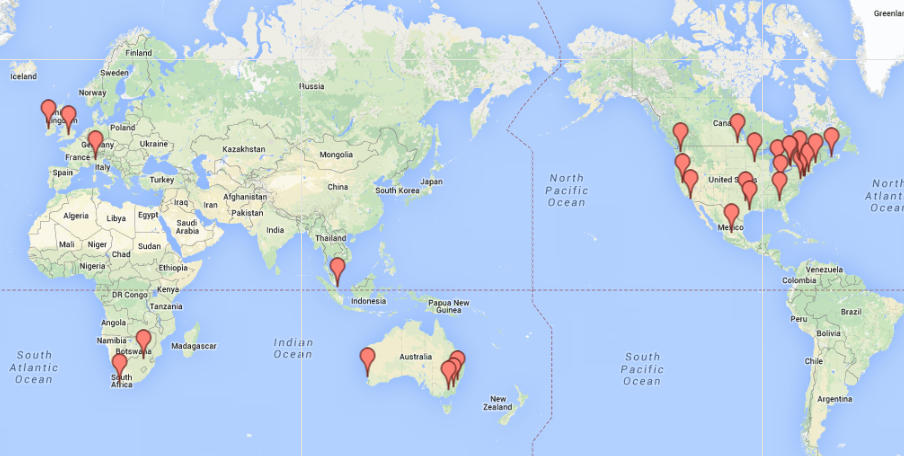
I made a map, so I could see the patterns and gaps left on a globe. I make no claims to speak for any parts of the world in this research, even the part I inhabit: at the same time, I think this visual of the locales of actual volunteers makes the situatedness of this project and whatever knowledges emerge from it very vivid. Note the huge swaths of human society from which I heard not a peep.

Screen shot 2014-02-25 at 11.51.20 AM

location of study volunteers

Within the areas I did hear from, homophily was an issue: nearly half of the volunteers turned out to be white Ph.D students, as I am. A third were also concentrated in eastern North America, where I reside. Only seven of the thirty were male. None self-identified outside traditional cisgender categories. Seeing all this laid out onscreen reinforced for me the importance of trying to design for diversity of voices: even though my call for participants was shared at least 150 times (as visible from within my Twitter account alone) and circulated far beyond the borders of my known networks, the majority of those who stepped forward bore some categorical commonality with my own identities. This reality made me ruefully aware of the ways in which my research will, like all research, reflect my own situated knowledge(s) as well as those of participants, whatever the efforts I make towards multiplicity.

Step Three:  Who’s on Board?
In the end, I could not pare down to twelve participants. I chose fourteen, intending to interview at least eight…and assuming a couple might not necessarily complete the reflective tasks requested.

(I also chose another eight who agreed to act as exemplar identities for the others to reflect on: these folks were not formally participants but allowed me to explore with participants the ways in which they perceive and read the identity and reputation signals others share online. I am deeply grateful to the exemplars, as I am to every one who stepped forward to offer their names, their interest, their support, and their amplification of the call for participants.)

So. I’ve had the privilege, these past three months, of engaging in Twitter-based participant observation with these twenty-two people. Of the fourteen active participants, a couple have lived their networked lives doubly-situated: in Mexico and Vancouver; in one case, in Singapore and Western Australia, in another. Seven more are based across North America, one is in Ireland, one in South Africa, two in Australia, one in Italy. Ten are female; four male. Nine self-identified in the initial expression of interest either as “white” or effectively unmarked (ie. no disclosure of racial or ethnic heritage); the others identified respectively as black and US Southern, Malay, Latino, half-Indian, and Jewish. Four identified as gay or queer. One identified as autistic. One disclosed HIV-positive status during the course of the research. Another found out she had breast cancer the same week we began the research process. These various identifications formed some of the texture of our communications, to varying degrees: the intersection of embodied identities and identity positions with what networked publics enable and constrain was a part of what the research project was intended to dig into.

Three participants were entirely unknown to me before they expressed interest in the research, four were loose ties whose names I knew without much awareness of their work, four were moderately well-known to me, and three were individuals with whom I’d had fairly extensive networked interaction over the previous couple of years. (I’d met two of the three close ties in person, in academic conference settings). Seven are Ph.D students or candidates at various stages of completion, two of whom also hold longstanding secure administrative or teaching positions within their institution. Three are early career scholars, one on tenure-track. Three are senior professors or researchers within their institutions – one has recently transitioned from a longstanding educational consultancy role within an institution to a research professor appointment there – and one is a director on a five-year alt/ac contract with a research institution. The majority are in their 30s, 40s, and 50s. In terms of scale of networks, their Twitter accounts range from a few hundred followers to thirteen thousand followers. Among the exemplars, there is even greater range in scale. Academic disciplines represented by the twenty-two participants and exemplars include but are not limited to Communications and Culture, Educational Psychology, History, Chemistry, Rhetoric and Writing, Online Learning and Educational Technologies, Public Administration and Political Science, Literature, Social Work, Information Technology, Anthropology and Sociology, and Education.

It’s been an extraordinary couple of months. Participants’ generosity in terms of time, intimacy, and tolerance for my almost-constant presence has been remarkable, as has their ongoing contribution to my research not *just* as participants but as resources and curators of a pretty steady stream of meta-information related to my study. The real challenge of networked research, I suspect, is information abundance – at the end of three months’ intensive observation, I not only have thousands of favourited tweets and dozens of blog posts to wade through as data, but literally hundreds of journal and news articles shared by participants that *may* reflect on the research questions of identity and scholarship, and may shape the course of my own meaning-making. If I can manage to read them without drowning.

So that’s where my research began, and with whom. Next time, I’ll take up the how of doing ethnography via Twitter, and how I grappled with the identity challenges of looking at…identities. :)